




Security scans that interrupt your CI pipeline with noise get ignored. Developers learn fast that when a tool flags hundreds of issues with no clear priority, the safest move is to route around it. The core problem is friction: separate logins, unclear severity rankings, and findings that require security expertise to interpret. A dev-first AppSec program removes that friction by surfacing only what's actionable in the tools developers already use, keeping remediation in their hands where it belongs.
TLDR:
- Over 70% of developers report security slows them down, driving avoidance behavior.
- Dev-first AppSec embeds security into IDEs, pull requests, and CI/CD pipelines.
- Track developer adoption rate and false positive rate alongside vulnerability count.
- Over 40% of new code is now AI-assisted, creating a governance gap for AppSec teams.
- Arnica surfaces security findings inside pull requests with pipelineless risk detection.
Why Traditional AppSec Fails Developers
Security tools built for auditors don't work for developers. That's the core problem.
Most AppSec programs were designed around compliance checkpoints and quarterly scans, not the daily rhythm of writing, reviewing, and shipping code. When security lives in a separate team with a separate toolset, developers get vulnerability reports they didn't ask for, can't act on quickly, and often don't understand.
The result? Alerts get ignored. Backlogs grow. Real risk accumulates.
Dev-first AppSec flips this by meeting developers where they already work, embedding security feedback directly into code review, CI pipelines, and the tools developers use every day. Instead of forcing context switches to separate portals or ticket queues, security findings surface at the point of code creation with enough context to act immediately. This reduces mean time to remediation because developers can fix issues in the same workflow where they introduced them. The shift goes beyond earlier detection to making secure coding the path of least resistance.
The Friction Problem: Why Developers Ignore Security Tools
Security tools that developers ignore don't make software safer. They just create audit trails.
The core problem is friction. When security scanning interrupts a build with hundreds of findings, most of which are low-severity noise, developers learn to tune it out. When a tool requires a separate login, a different workflow, or a ticket to a team they rarely talk to, the path of least resistance is always to ship first and fix later.
Research backs this up. Over 70% of developers report that security slows them down, and that perception alone drives avoidance behavior. A Secure Code Warrior survey found 86% of developers don't view application security as a top priority when writing code.
Dev-first AppSec flips this by meeting developers in the tools they already use, surfacing only what's actionable, and keeping remediation in their hands.
What Dev-First AppSec Actually Means
Dev-first AppSec puts security directly in the developer's workflow instead of treating security as a separate gate at the end of the process. The goal is simple: make secure coding the default path.
In practice:
- Security findings surface in the IDE or pull request, not a ticket queue that developers check once a week.
- Guidance is actionable instead of a CVE number and a severity score that leaves engineers guessing.
- Noise is reduced so developers fix real risks instead of triaging hundreds of low-priority alerts.
The result is a program that developers engage with because it fits how they already work.
Shift Left Without Shifting the Burden
"Shift left" has become the rallying cry of AppSec teams everywhere. The idea is sound: catch vulnerabilities earlier, before they calcify into production risk. The execution, though, often falls flat. Security gets pushed into developer workflows without the context, tooling, or feedback loops that make it actionable. The result is alert fatigue, compliance theater, and developers who learn to click "dismiss" faster than they read the finding.
Shifting left only works when you shift the right things. Developers need findings they can act on immediately, in the tools they already use, with enough context to understand why it matters.
Building Developer-Native Security Workflows
Security tools that live outside the developer workflow get ignored. The fix isn't better documentation or mandatory training sessions. It's building security into the tools and processes developers already use every day.
That means meeting developers in their IDEs, their pull requests, and their CI pipelines with actionable, context-rich feedback instead of a flood of unranked alerts. When findings surface where code gets written, remediation happens faster and friction drops.
A few principles make this work:
- Findings should map directly to the line of code causing the issue, with enough context for a developer to fix it without opening a separate ticket or reading a lengthy report.
- Severity scoring should reflect actual exploitability and business context, so developers spend time on what matters instead of triaging noise.
- Feedback loops should be fast enough that security feels like part of the build process, not a gate at the end of it.
Metrics That Actually Matter for Dev-First AppSec
Tracking the wrong metrics is one of the fastest ways to lose developer trust. Vulnerability count and time-to-close tell you almost nothing about whether your program is working.
The metrics worth watching:
- Mean time to remediate by severity, not overall, so teams can see where friction actually lives.
- Developer adoption rate, meaning the percentage of engineers actively using security tooling without being forced to.
- False positive rate per tool, because high false positive rates are the single biggest reason developers stop paying attention.
- Security findings caught pre-merge versus post-merge, which shows whether your program is shifting left in practice.
If developers are routing around your tools, the metrics will show it.
Choosing Tools Developers Will Actually Use
Tool adoption lives or dies on friction. If a security tool interrupts a developer's workflow, generates noise, or requires context-switching to a separate portal, it gets ignored.
The best dev-first AppSec tools share a few traits:
- They integrate directly into the IDE or CI/CD pipeline so findings surface where developers already work.
- They explain vulnerabilities in plain language with fix guidance attached instead of a bare CVE number and a severity score.
- They produce low false-positive rates, because nothing kills trust faster than flagging clean code repeatedly.
- They rank findings by actual exploitability, helping developers focus on what matters instead of triaging noise.
The goal is a tool that feels like a helpful code reviewer, not a compliance checkpoint.
Governance and AI-Generated Code in Dev-First Programs
AI-generated code is arriving faster than most security reviews can keep up with. GitHub reports that over 40% of new code in some repositories is now AI-assisted, and that number is climbing. For dev-first AppSec programs, this creates a governance gap worth taking seriously.
AI tools write code that looks clean but may carry subtle vulnerabilities. Developers trust the output. Security teams rarely see it until a scan flags something in staging.
A dev-first program closes that gap by embedding policy directly into the workflow where AI code gets reviewed and committed, not downstream where the damage is harder to undo.
How Arnica Delivers Dev-First AppSec at Scale
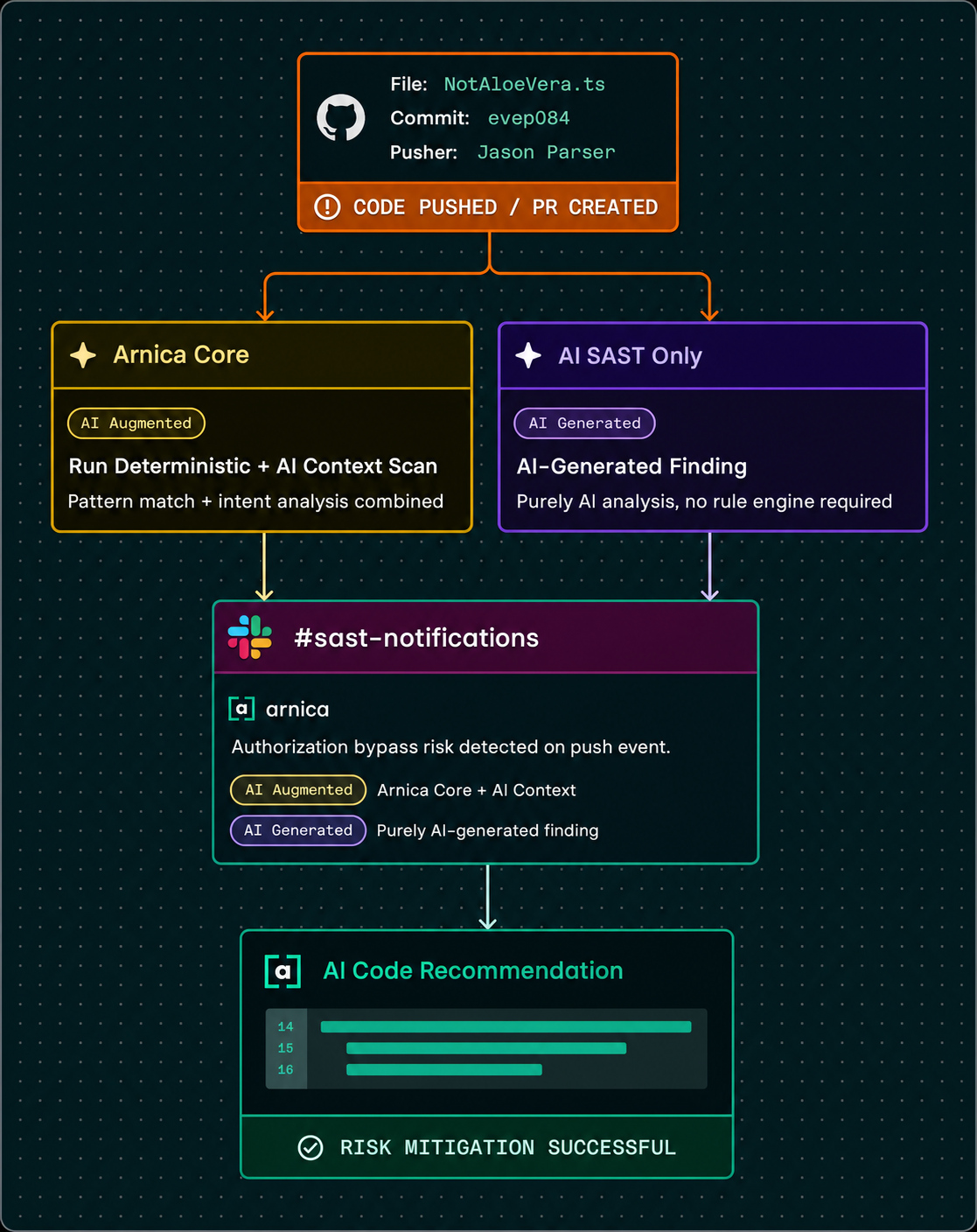
Arnica approaches dev-first AppSec by meeting developers where they already work. Security feedback surfaces directly inside pull requests, IDEs, and CI/CD pipelines, so findings reach the right person at the right moment without requiring a context switch to a separate security portal.
The core insight is that friction kills adoption. When developers have to leave their workflow to triage alerts, they disengage. Arnica removes that friction by making secure coding the default path, not an obstacle layered on top of it.
Key capabilities that support this include:
- Pipelineless risk detection that catches exposures before the build stage, reducing mean time to remediation without waiting for CI runs.
- AI-assisted auto-remediation that surfaces fix suggestions inline, so developers resolve findings without needing deep security expertise.
- Prioritization based on reachability and business context, cutting through alert noise so teams focus on what actually matters.
Final Thoughts on Dev-First AppSec That Actually Gets Used
If your developers are ignoring security tools, the problem isn't training or enforcement. It's friction. Security that lives outside the code review process, generates alert fatigue, or requires separate workflows gets treated as optional no matter how many policies you write. Check out Arnica to see what happens when security feedback lands in pull requests with enough context to act on immediately. When you remove the friction, developers stop avoiding security and start fixing it as part of their normal workflow.
FAQ
What's the difference between dev-first AppSec and traditional shift-left security?
Dev-first AppSec embeds security feedback directly into the tools developers already use (IDEs, pull requests, CI/CD pipelines) with actionable, low-noise guidance, while traditional shift-left often just moves the same alert-heavy processes earlier in the pipeline without reducing friction. The goal is making secure coding the path of least resistance, not adding more gates developers learn to ignore.
Can I reduce false positives without missing real vulnerabilities?
Yes, by using tools that rank findings based on actual exploitability and business context instead of raw vulnerability counts. Focus on findings that reflect reachability, EPSS scores, and KEV listings so your team spends time on risks that matter. Low false-positive rates are critical because repeated clean-code alerts kill developer trust faster than any other factor.
How do I handle security for AI-generated code at scale?
Embed policy enforcement directly into the workflow where AI code gets reviewed and committed, not downstream where issues are harder to fix. Over 40% of new code in some repositories is now AI-assisted, so governance needs to happen at the point of generation through pull request reviews, IDE integration, and CI/CD checks that catch vulnerabilities before they reach production.
What metrics should I track to know if developers are actually using security tools?
Track developer adoption rate (percentage of engineers actively using the tools), mean time to remediate by severity (not overall), false positive rate per tool, and the ratio of security findings caught pre-merge versus post-merge. If developers are routing around your tools or ignoring alerts, these metrics will show the gap between deployment and real engagement.
Dev-first AppSec vs traditional AppSec programs?
Dev-first AppSec delivers security findings in the developer's existing workflow (IDE, PR comments, Slack) with actionable fix guidance and risk-based prioritization, while traditional programs generate ticket queues that security teams triage and developers check infrequently. The structural difference is friction: dev-first tools feel like a helpful code reviewer, traditional tools feel like a compliance checkpoint.
Reduce Risk and Accelerate Velocity
Integrate Arnica ChatOps with your development workflow to eliminate risks before they ever reach production.