

If your SBOM strategy depends on “adding one more job to the pipeline”, you’ve already accepted the tradeoff: slower CI in exchange for compliance artifacts you still don’t fully trust.
And therein lies the trap. SBOM generation should be continuous, repo-native and searchable on demand, without turning every pull request into a security checkpoint bottleneck. So how do you keep CI fast, keep inventory current and give AppSec the evidence they need when auditors (or the next supply chain incident) come knocking? Here’s how to generate a software bill of materials from your repositories without slowing CI.
Why SBOM From CI Breaks Down at Scale
Teams usually start SBOM generation in CI because builds are where dependencies “finalize”. In practice, however, in-pipeline SBOM workflows fail in three predictable ways:
- Latency compounds - Dependency resolution plus SCA/SBOM tooling, plus artifact upload, adds minutes per run. Multiply that by PR volume, monorepo size, and parallel pipelines, and you end up with the recurring cost of developer friction.
- Coverage is incomplete - CI-based scans often miss code paths and dependency contexts that don’t hit the “main” build workflows. That gap only becomes painfully evident during incident response when the question “Do we use X?” needs an answer in seconds.
- Ops burden increases - Maintaining scanner versions, caching strategies, credentials, and build-time exceptions suddenly becomes a DevOps tax. The pipeline gates weaken, exceptions pile up, and trust in the output diminishes.
For this reason, the goal isn’t “generate an SBOM” but rather to generate an SBOM continuously, from your repositories, with full coverage, without putting the cost on CI.
Continuous Repo-Native SBOM Generation
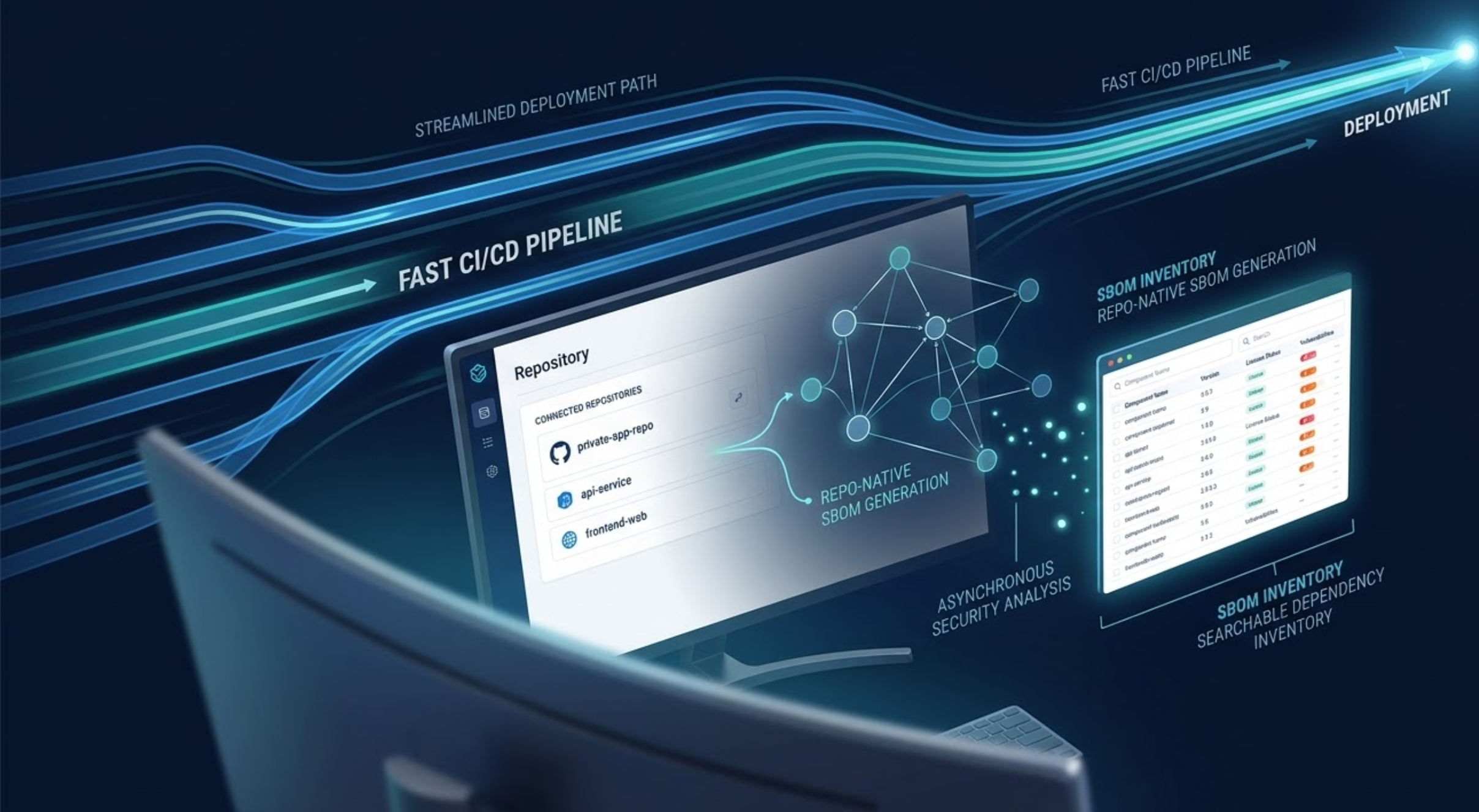
At Arnica, we call this pipelineless security – the ability to monitor and analyze code in real-time without slowing CI/CD, all while reducing bottlenecks and detecting risk earlier in the development lifecycle. For SBOM generation, that means:
Generate SBOMs Without Waiting on Pipelines
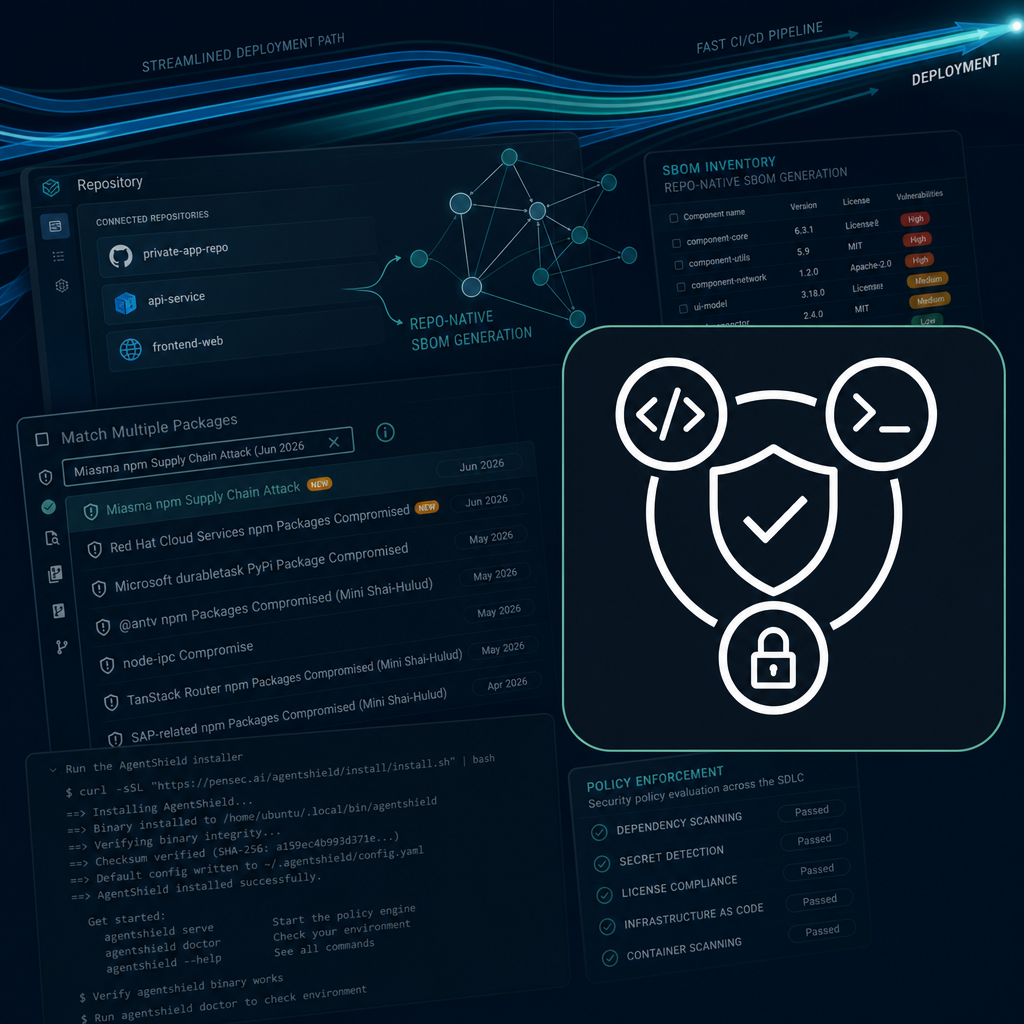
Rather than tying SBOM creation to every PR build, run dependency discovery and inventory updates asynchronously. Arnica’s SBOM is always up to date, with quick search and export so you can prove supply chain security and compliance without needing to wait on pipelines.
This way, CI stays focused on test, build, and deploy while SBOM data stays current across repos. You also benefit from faster incident response because you’re querying inventory, not triggering scans.
Make SBOM Searchable First and Exportable Second
Most organizations treat SBOMs like PDFs: generate, store and forget, until it’s audit season. A modern SBOM workflow focuses on inventory first.
- Identify packages across repositories
- Understand where they’re used
- Map versions, licenses and risk and
- Export CycloneDX/SPDX when needed (for instance, for customers, auditors or procurement)
Arnica’s SBOM inventory is filterable, searchable and exportable, including enriched Cyclone DX across integrated repositories.
Use Incremental Strategies for Monorepos and High-Churn Codebases
Monorepos and large dependency graphs are where the notion of “scan everything every time” falls apart. Incremental scanning strategies, including diff-aware analysis, targeted dependency evaluation, and asynchronous processing, let you keep visibility without dealing with the traffic jam that is never-ending full scans.
So how do you implement SBOM generation from repositories in a way that keeps your developers satisfied and still scales? Follow these steps:
- Connect Your SCM and Establish a Baseline Inventory - Start by integrating your repositories so you can create a baseline SBOM inventory across teams. From there, you can shift to continuous updates rather than periodic scans.
- Update Continuously Outside the Pipeline - Move dependency mapping to an asynchronous cadence. The right interval depends on your environment. High change repos might require daily updates, but lower-change repos could be weekly (as long as you force refresh during incidents)
- Keep CI Gates Focused on “Must-Fail” Issues - CI is still the right place for a small number of high-signal checks like breaking tests, critical policy violations and release integrity rules. But avoid turning CI into a dependency intelligence engine. Your SBOM/inventory platform should do that work, using policy to escalate only what truly needs to block.
- Add Post-build SBOM Validation Only When You Need Artifact-Level Facts - There are cases where repo-level visibility isn’t enough, like dependencies pulled from multiple private sources at build time, or compiled artifacts that materially change dependency composition. In these cases, use a post-build scan strategy that validates SBOMs from CI/CD via API rather than moving the whole SBOM workload into your pipeline.
- Operationalize SBOM for Audit and Incident Response - Real SBOM value shows up during audit and compliance or supply chain incidents. When you need to prove you know your third-party footprint and can produce artifacts quickly, or when a compromise package hits the news and your CEO asks, “Are we affected?” you’ll want to have fast, confident answers.
Teams that truly excel at supply chain security treat SBOM as a living map of their software reality: something that’s continually updated from source, instantly searchable, and ready to export when the world demands proof. The good news is, you don’t have to pay for that map with slower CI.
Arnica’s pipelineless security is designed to make security a native, integrated part of developer workflows, not just an added tax on them, and the difference has a true ripple effect.
By generating SBOMs asynchronously from repositories, using incremental strategies for scale and reserving post-build validation for the few cases where artifacts are the only source of truth, you get the best of both worlds. If you’re ready to experience what it’s like to have high-confidence inventory and fast delivery, we invite you to learn more about Arnica and what pipelineless security is all about.
Get started with Arnica today and get free git posture management, secret scanning, SCA, SAST, SBOM, IaC, Open Source Compliance and Reputation and more. Integrate it all in seconds, with no credit card needed. See what’s possible and take your next steps with confidence, including easy, actionable feedback via ChatOps that developers can’t get enough of. With Arnica, it really is that easy.
TLDR
Generating SBOMs through CI pipelines slows development and often produces incomplete or outdated results. As teams scale, in-pipeline SBOM workflows add latency, increase operational burden, and fail to deliver the fast answers needed during audits or supply chain incidents. A better approach is continuous, repo-native SBOM generation that runs asynchronously outside CI. By analyzing repositories directly, teams can maintain a living, searchable inventory of dependencies without blocking builds or pull requests. Incremental strategies make this approach scalable for monorepos and high-churn environments, while CI gates remain focused on only the highest-signal failures. SBOMs should be searchable first and exportable only when needed. This model gives AppSec teams reliable evidence on demand while preserving fast delivery and developer satisfaction.
Reduce Risk and Accelerate Velocity
Integrate Arnica ChatOps with your development workflow to eliminate risks before they ever reach production.