
Secure Development Lifecycle for Security Leaders (July 2026)


.png)
.png)
Your developers are probably already using some form of static analysis. Your pipeline might have a secrets scanner. But a collection of tools isn't a secure development lifecycle. A real SDL ties security requirements, threat modeling, testing gates, and post-release monitoring into a repeatable framework that runs across every phase of development, whether you're following NIST's Secure Software Development Framework, the Microsoft Security Development Lifecycle, or an agile secure development lifecycle adapted for DevSecOps. Here's how to build one that actually reduces risk instead of just checking a compliance box.
TLDR:
- A genuine SDL distributes risk detection across every phase, from threat modeling in design to monitoring post-release, beyond a final pen test.
- IBM 2024 Data Breach Report puts the average breach at $4.88 million, with development-introduced vulnerabilities accounting for a material share of that exposure.
- Your SDL policy needs enforceable thresholds: builds fail on unresolved critical SAST findings, and high-severity CVEs in dependencies block deployment until patched or formally accepted.
- Baseline your program against OWASP SAMM, set a 90-day target for one practice area, and track mean time to remediate as your primary signal of real progress.
- Arnica scans code continuously in AI-assisted development environments, surfacing secrets, supply chain risks, and findings at commit time, not after a sprint closes.
What a Secure Development Lifecycle Is
A secure development lifecycle (SDL) is a structured approach to building software where security requirements, testing, and validation are woven into every phase of development, not applied after the fact. The goal is straightforward: catch vulnerabilities where they are cheapest to fix, which is before code ships.
Most teams understand the concept. Fewer implement it well. The gap between knowing SDL exists and running one that actually reduces risk is where most security programs stall.
The Core Idea
SDL sits at the intersection of software engineering and security governance. It gives development teams a repeatable set of activities tied to each stage of the software development lifecycle, from requirements gathering through deployment and maintenance. Security stops being an audit event and becomes a continuous practice, which is central to securing your development ecosystem.
Frameworks like OWASP's Secure Software Development Lifecycle Project, NIST guidelines, and Microsoft's Security Development Lifecycle each express this differently, but share the same underlying logic:
- Security requirements belong in the design phase, not the defect backlog
- Threat modeling should happen before a line of code is written
- Testing gates should catch security issues before they reach production
- Post-release monitoring closes the loop on vulnerabilities that slip through
Why the Definition Matters
Calling something an SDL when it only covers penetration testing at release is a common mistake, and an expensive one. Understanding the role of SCA and SAST helps clarify where those testing gaps occur. A pen test at the end of a release cycle finds real issues at the worst possible time, when rework costs are highest and timelines are tightest. A genuine SDL distributes that risk detection across the entire build process.
Why a Secure Development Lifecycle Matters
Organizations that skip structured security practices don't just accumulate technical debt; they accumulate liability. IBM 2024 Data Breach Report found the average breach now costs $4.88 million, and vulnerabilities introduced during development account for a material share of that exposure.
A secure development lifecycle gives security and engineering teams a shared framework for catching those vulnerabilities before they ship, not after a pen tester or attacker finds them first.
Secure Development Lifecycle Phases
Each phase of the SDL carries distinct security obligations. Skipping or shortcutting any one of them is where vulnerabilities get baked in, not caught later.
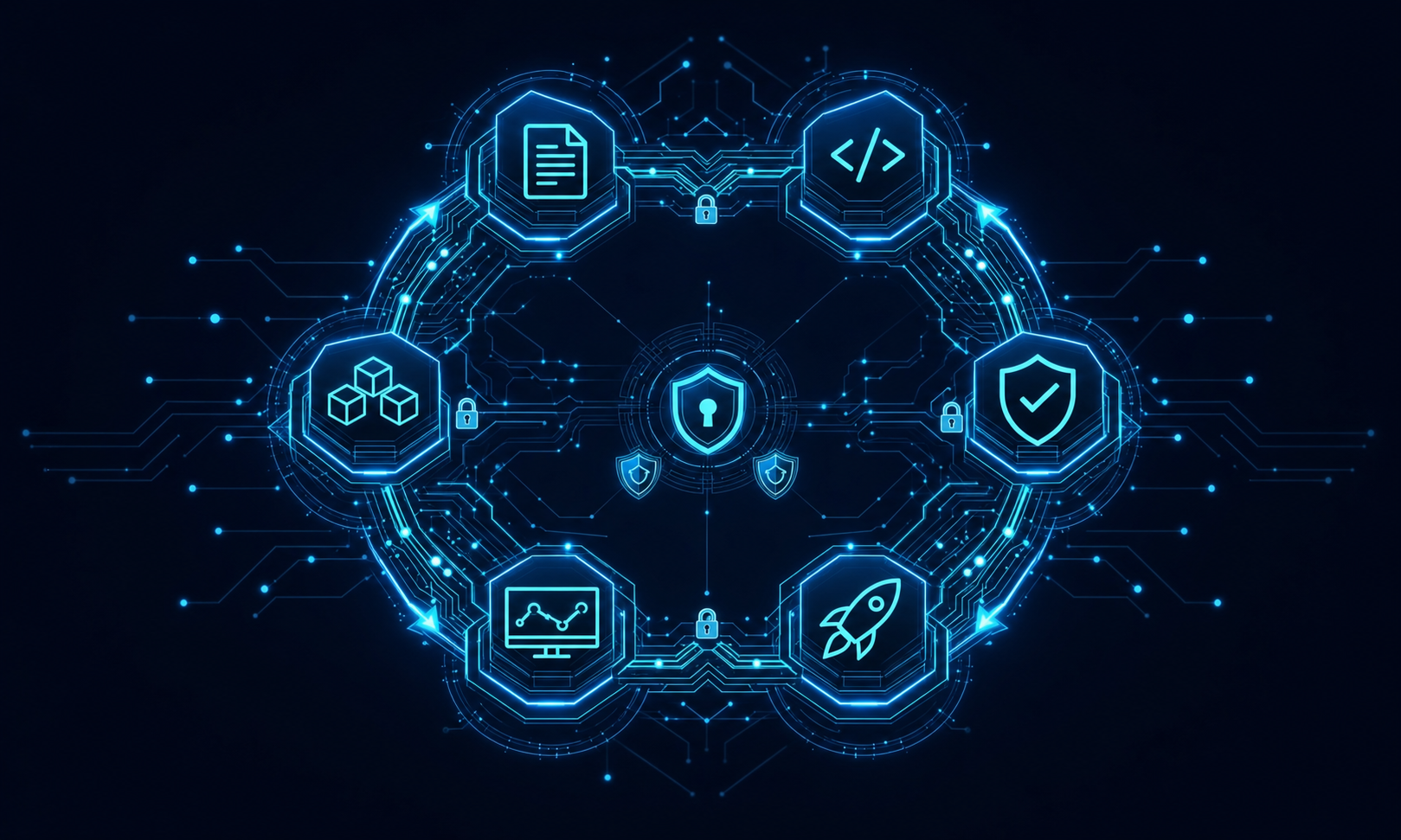
- Requirements: Security requirements get defined here, tied directly to compliance mandates like NIST SP 800-53 or PCI DSS. Teams document what data the system handles, who accesses it, and what regulatory constraints apply.
- Design: Threat modeling happens in this phase. Teams map attack surfaces, assign risk ratings, and decide which controls belong in architecture before a line of code is written.
- Implementation: Developers write code against secure coding standards. Developer-centric security testing runs continuously, flagging issues like CWE-89 or CWE-798 before they reach review.
- Testing: Runtime analysis, penetration testing, and dependency scanning run against a working build. This is where OWASP Top 10 coverage gets verified.
- Deployment: Security configuration is validated, secrets management is confirmed, and release gates enforce that no critical findings ship.
- Maintenance: Vulnerability disclosure processes activate, patches get tracked against SLAs, and monitoring catches what pre-release testing missed.
Core Security Practices for Each Phase
Each phase of the secure development lifecycle demands specific security activities, not generic checklists applied uniformly.
Requirements
Capture security and privacy requirements alongside functional ones. Define misuse cases, identify regulatory obligations, and set measurable acceptance criteria for security controls.
Design
Conduct threat modeling using STRIDE or PASTA. Document trust boundaries, data flows, and attack surfaces before writing a single line of code.
Implementation
Enforce secure coding standards, run real-time SAST tools in the IDE, and require peer review for security-sensitive components.
Testing
Run DAST, fuzz testing, and dependency scanning. Penetration testing should happen before any release candidate is approved.
Deployment and Maintenance
Automate security configuration validation in CI/CD pipelines. Track vulnerabilities post-release and maintain a defined incident response path tied directly to affected components.
Secure Development Lifecycle Frameworks
Three frameworks have shaped how the industry thinks about building security into software development. Each takes a different approach, and understanding the differences helps you choose the right foundation.
Microsoft SDL
Developed by Microsoft after a wave of critical vulnerabilities in the early 2000s, the Microsoft Security Development Lifecycle introduced security requirements, threat modeling, and mandatory code review as standard engineering checkpoints. It remains a widely referenced baseline; Microsoft last updated the SDL guidance in 2022.
OWASP SAMM
The OWASP Software Assurance Maturity Model gives teams a scored, maturity-based view across governance, design, implementation, verification, and operations. It works well for organizations benchmarking current state against a defined target.
NIST SSDF
NIST's Secure Software Development Framework maps practices to existing standards and regulatory requirements, making it the preferred reference for teams operating under federal mandates or compliance-heavy environments.
| Framework | Origin & Purpose | Key Strength | Best Fit |
|---|---|---|---|
| Microsoft SDL | Developed in the early 2000s after a wave of critical Windows vulnerabilities; introduced security requirements, threat modeling, and mandatory code review as engineering checkpoints | Concrete, phase-by-phase checkpoints teams can adopt immediately | Teams new to structured security requirements looking for a proven baseline |
| OWASP SAMM | Vendor-neutral maturity model covering governance, design, implementation, verification, and operations | Scored, maturity-based assessment that benchmarks current state against a defined target | Organizations measuring SDL progress and identifying practice-area gaps |
| NIST SSDF | Maps secure development practices to existing standards including NIST SP 800-53, PCI DSS 4.0, and NIST SP 800-218 | Direct alignment to regulatory requirements; produces audit-ready evidence of active controls | Teams under federal mandates or operating in compliance-heavy environments |
Secure SDLC in Agile and DevSecOps Environments
Agile sprints and DevSecOps pipelines broke the old waterfall assumption that security reviews happen at the end. When you're shipping multiple times a day, "we'll check security before release" stops being a policy and starts being a liability.
The fix is shifting security left: running automated scans, secrets detection, and dependency checks via CI/CD pipeline security so every commit gets a security verdict before it merges. Self-service code scanning can begin at the moment a developer opens a pull request.
- Static analysis runs on every pull request, catching injection flaws and misconfigurations before code is reviewed by a human.
- Dependency checks flag known vulnerable packages the moment they're introduced, not weeks later during a scheduled audit.
- Secrets detection blocks hardcoded credentials from ever reaching a shared branch.
The goal is keeping feedback loops tight enough that a developer sees a security finding in the same window they see a failing unit test.
Common Vulnerabilities and Attack Vectors in the SDLC
Each phase of the SDLC introduces distinct attack surfaces. Understanding where vulnerabilities enter is the first step toward stopping them before they compound.
- Injection flaws (SQL, command, LDAP) originate in the coding phase when input validation is skipped or inconsistent.
- Hardcoded credentials surface during development and persist into production because secret scanning is absent from the pipeline.
- Insecure dependencies enter during build when third-party libraries are pulled without version pinning or integrity verification; real-time SCA catches these before they reach production.
- Misconfigured infrastructure gets baked in during deployment when security review happens after provisioning, not before.
- Broken access controls trace back to design-phase decisions where authorization models were never threat modeled.
Secure SDLC Tools and Automation
The right toolchain separates a secure SDLC that exists on paper from one that actually catches vulnerabilities before they ship. Most teams rely on a layered set of capabilities across four categories.

- Static analysis (SAST) scans source code without executing it, catching injection flaws, hardcoded credentials, and insecure API usage early in development.
- Runtime analysis (DAST) runs against live applications to surface vulnerabilities that static scanning misses.
- Software composition analysis (SCA) tracks open-source dependencies and flags known CVEs before they reach production.
- Threat modeling tools like Microsoft's SDL Threat Modeling Tool help teams reason about attack surfaces during design, before a single line of code is written.
OWASP's secure development resources, including the OWASP SAMM maturity model, give teams a vendor-neutral benchmark for identifying where their toolchain has gaps.
Building a Secure SDLC Policy
A secure development lifecycle policy is the governing document that converts security intent into enforceable practice. Without one, even well-intentioned teams default to inconsistent behavior across projects and teams.
At minimum, a policy should define:
- Which secure SDLC framework applies (NIST, OWASP, Microsoft SDL, or a hybrid) and why that choice fits your environment.
- Mandatory security activities at each phase, from threat modeling in design through penetration testing before release.
- Roles and accountability, specifying who owns security sign-off at each gate.
- Tooling requirements, naming which scanners, SCA tools, and secrets detection run at which pipeline stages, including whether pipelineless security fits your architecture.
- Exceptions handling, with a documented waiver process that includes risk acceptance sign-off and remediation timelines.
A policy without teeth is just documentation. Designing automated security workflows gives every requirement a measurable threshold: a build fails if critical SAST findings go unresolved, secrets committed to the default branch trigger an immediate incident response workflow, and third-party components with known high-severity CVEs block deployment until patched or formally accepted.
Review the policy at least annually, and after any material breach or audit finding. Regulatory requirements under frameworks like PCI DSS 4.0 and NIST SP 800-218 (the Secure Software Development Framework) now expect organizations to produce evidence that secure development controls are active, not merely written down.
Measuring Secure SDLC Maturity and Continuous Improvement
Maturity models give security leaders a structured way to assess where their secure SDLC actually stands versus where they assume it stands. The OWASP Software Assurance Maturity Model (SAMM) and BSIMM are the two most referenced frameworks for this assessment.
Approaches like pipelineless SAST for application security can accelerate improvement. Three signals indicate a program moving in the right direction:
- Mean time to remediate security findings is trending down across releases
- Developer security training completion rates are climbing, with findings per developer decreasing over the same period
- Security gates are catching defects before they reach production, not after
Baseline your current state against OWASP SAMM, set a 90-day target for one practice area, and track the metrics above to confirm progress is real.
How Arnica Secures the Agentic Development Lifecycle
Arnica was built for exactly this environment: AI-assisted, high-velocity development where the attack surface expands with every code generation request.
As LLMs write more code, the SDL can't rely on periodic reviews or manual checkpoints. Arnica runs continuously alongside your development workflow, scanning code as it's written before it ships. That continuous scanning is the foundation of building an AppSec program powered by pipelineless security.
Here's what that looks like in practice:
- Self-service code scanning starts the moment a developer commits, not after a sprint closes or a pipeline runs on a schedule.
- Secrets detection catches hardcoded credentials and tokens before they reach version control, where remediation costs multiply.
- Software supply chain risk is monitored across your dependency graph, flagging malicious packages and suspicious maintainer behavior in real time.
- Developer-facing findings are surfaced with enough context to act on immediately, keeping remediation inside the workflow where the code was written.
Arnica's approach reflects a core SDL principle: security feedback that arrives too late gets ignored.
Final Thoughts on Running a Secure Software Development Lifecycle
Building security into your development process from requirements through deployment keeps vulnerabilities where they are cheapest to fix. The right framework, the right toolchain, and clear accountability at each phase are what make it stick. Try Arnica for free and start catching findings before they leave your pipeline.
FAQ
What are the secure development lifecycle phases and what security activities belong in each one?
The secure development lifecycle runs through six phases: requirements, design, implementation, testing, deployment, and maintenance. Each phase carries distinct security obligations: threat modeling happens in design before any code is written, static analysis runs continuously during implementation, and dependency scanning runs against a working build during testing. Skipping or shortcutting any phase is where vulnerabilities get baked in instead of caught.
Microsoft SDL vs OWASP SAMM vs NIST SSDF: which secure development lifecycle framework should I use?
The right framework depends on your environment and compliance obligations. Microsoft SDL is a strong baseline for teams new to structured security requirements and mandatory code review checkpoints. OWASP SAMM works well when you want a scored, maturity-based view to benchmark current state against a target. NIST SSDF is the preferred reference for teams operating under federal mandates or compliance-heavy environments like PCI DSS 4.0 or NIST SP 800-218.
How do I build a secure SDLC policy that teams actually follow?
A secure development lifecycle policy needs both defined requirements and measurable thresholds that enforce them. At minimum, name which framework applies and why, specify mandatory security activities at each phase, assign accountability for sign-off at each gate, and document your tooling requirements. Pair every requirement with a concrete enforcement rule: a build fails on unresolved critical SAST findings, committed secrets trigger an immediate incident response workflow, and components with high-severity CVEs block deployment until patched or formally accepted.
When can self-service code scanning begin in an agile secure development lifecycle?
Self-service code scanning can begin the moment a developer opens a pull request. In agile and DevSecOps environments, static analysis runs on every pull request, dependency checks flag vulnerable packages the moment they are introduced, and secrets detection blocks hardcoded credentials before they reach a shared branch. The goal is keeping feedback loops tight enough that a developer sees a security finding in the same window they see a failing unit test.
How does Arnica fit into a secure software development lifecycle for teams using AI coding agents?
Arnica was built for AI-assisted development where the attack surface expands with every code generation request. It runs continuously alongside the development workflow, scanning code at the moment of commit, catching secrets before they reach version control, monitoring software supply chain risk across the full dependency graph, and surfacing findings with enough context for developers to act without leaving their existing workflow. Where traditional secure SDLC tools rely on periodic reviews or manual checkpoints, Arnica treats security feedback that arrives too late as security feedback that gets ignored.
Reduce Risk and Accelerate Velocity
Integrate Arnica ChatOps with your development workflow to eliminate risks before they ever reach production.