
.png)

Wiz Code is the code module of the Wiz cloud platform, and its defining strength is code-to-cloud context. The Wiz sensor sees the deployed workload, so a vulnerable component that is actually running and internet-exposed ranks ahead of a theoretical one. For a team that has already standardized on Wiz for cloud security and wants its code findings ranked by live cloud exposure, that correlation is a real reason to run Wiz Code.
Why Choose Arnica vs. Wiz Code?
The case for Arnica is the source-code layer itself, and it is the layer where an AI-era program now lives. Arnica connects once through your SCM (Source Code Management; GitHub, GitLab, Azure DevOps, Bitbucket) and scans every push across every repository, writes a managed security rule pack into each AI coding agent’s own configuration file so generated code is governed before it is written, routes each finding to the resolved human through an identity graph that handles departed authors and cloud-agent bot commits, rewrites git history to remove a committed secret, and re-engages the current owner when a CVE (Common Vulnerabilities and Exposures) crosses into the KEV (Known Exploited Vulnerabilities catalog, CISA) catalog.
Wiz Code is the right call for a buyer whose top need is cloud-runtime correlation across a full CNAPP (Cloud-Native Application Protection Platform); Arnica is the right call for a buyer whose top need is governing, routing, and remediating risk at the source-code layer regardless of where the code runs.
Where Arnica’s architecture differs from Wiz Code
Govern AI coding agents at the generation step, across every repo
A growing share of code is written by agents running in the cloud, with no developer workstation in the loop, and the only thing that shapes what such an agent writes is the rule set it reads while it generates. Arnica’s Agentic Rules Enforcer governs at generation by controlling those rules: it writes a managed rule block into the configuration files each agent loads on every run, kept in the repository itself, .cursor/rules/arnica-{alias}.mdc for Cursor, CLAUDE.md for Claude Code, .github/copilot-instructions.md for GitHub Copilot, GEMINI.md for Google Gemini Code Assist, AGENTS.md for the generic convention, and .augment/rules/ for Augment.
Because the rules live in the repo, they govern the agent whether it runs in an IDE on a laptop or as a Cursor or Copilot cloud agent. Delivery runs on a PR-piggyback pattern through the existing SCM connection, so coverage equals SCM coverage at 100% of connected repositories with no per-developer setup, the block self-heals if a developer deletes it, the default pack maps to OWASP ASVS Level 2 across about a hundred ARNIE_* Rule IDs (Arnica’s rule ID format), and agents cite the Rule ID inline so security can measure how often governed controls landed in committed code.
Wiz Code’s agentic guardrails are an IDE plugin and a per-workstation pre-commit or pre-push hook, plus an MCP server the agent can call; these scan or block at the workstation and the commit boundary, while an agent generating and committing in the cloud runs outside them, and Wiz describes generation-step governance as a roadmap direction.
Route findings to the right human, including cloud-agent commits
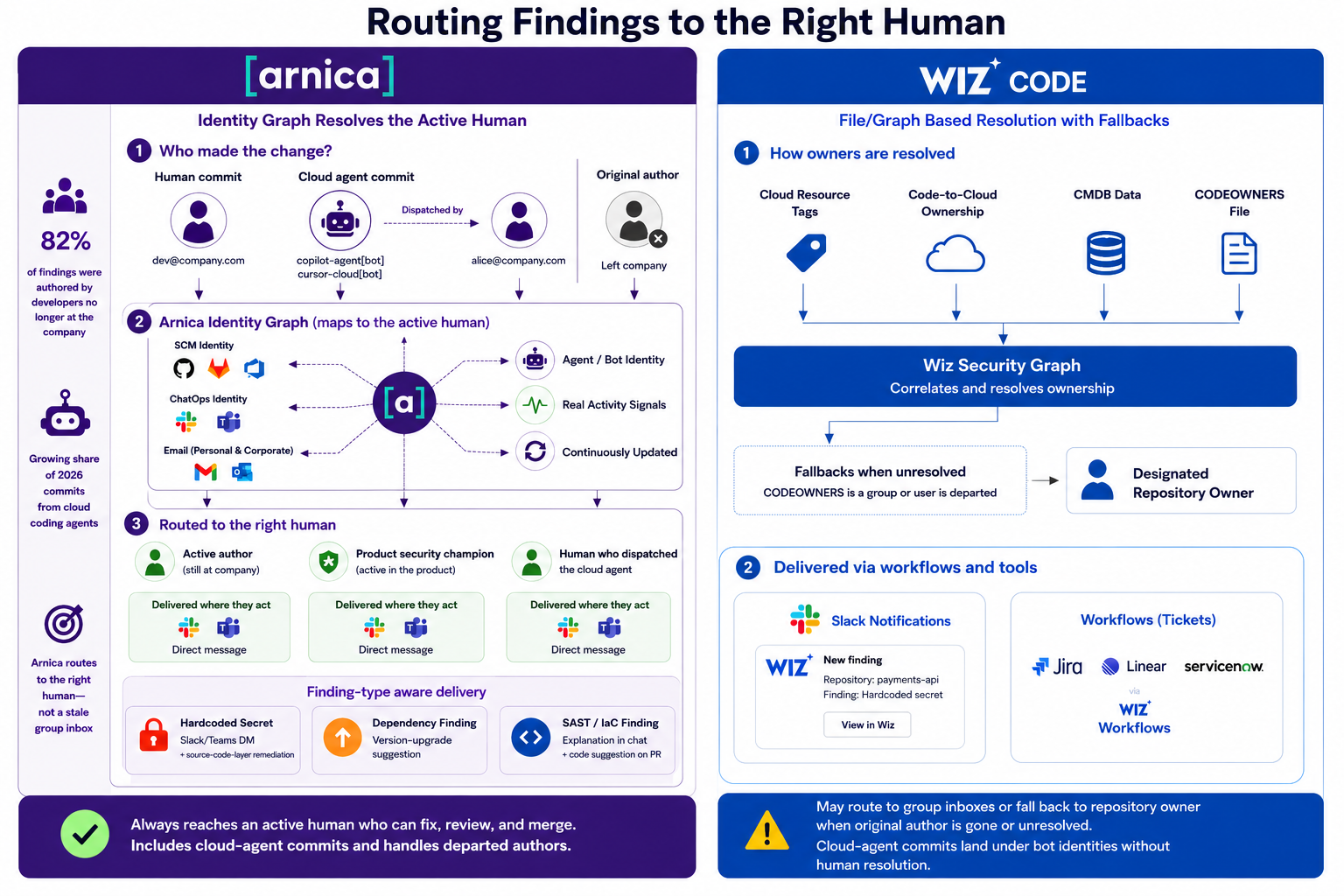
Routing only helps if it reaches a person who can act, and a static owner file rarely does. CODEOWNERS usually names a team alias rather than an individual, and the individuals it does name have often left or changed teams, so the routing target is a group inbox nobody reads or a person who is gone. On top of that, per Arnica’s internal benchmark 82% of findings were authored by developers no longer at the company, and a growing share of 2026 commits come from cloud coding agents (GitHub Copilot Agent, Cursor cloud agents) that land under bot identities.
Arnica’s identity graph resolves the active human rather than reading a file: it maps SCM identity, ChatOps (chat-based operations; Slack, Microsoft Teams) identity, personal versus corporate email, and agent-bot identity back to one person and keeps that mapping current from real activity. Two parts of it do work no analyzed competitor does. When a Copilot Agent or Cursor cloud-agent commit lands under a bot identity, Arnica resolves the human who dispatched the agent by mapping the bot identity and its initiating account back through the graph, so agent-authored code still has a human owner. And when the original author is gone, Arnica routes to a product-level security champion, a developer currently active in that product’s code who can fix, review, and merge the change, rather than a stale CODEOWNERS group. Delivery is finding-type-aware: a hardcoded secret triggers a Slack or Teams direct message plus source-code-layer remediation; a dependency finding lands as a version-upgrade suggestion; a SAST or IaC finding lands as an explanation in chat with a code suggestion on the pull request.
Wiz Code resolves owners through the Security Graph, using cloud resource tags, code-to-cloud ownership, CMDB data, and the CODEOWNERS file, and falls back to the designated repository owner when the entry resolves to a group or a departed user, delivering findings into Slack and into Jira, Linear, or ServiceNow tickets through Wiz Workflows.
Mitigate the secret in real time, the moment it's pushed
A committed secret is exposed from the instant it lands, and every minute it waits in a findings queue it is being cloned to laptops, mirrored into CI, and read by developers other than the one who committed it. By the time a backlog item is triaged, the secret should be treated as already seen. Arnica acts on the push itself, automatically: it removes the secret from the commit history so a git clone no longer exposes it, creates a branch with the secret masked and all other changes preserved, and sends the committing developer a single sync command in a direct message, with rotation of the live credential proceeding in the customer’s existing secrets workflow. Wiz Code scans the full git history, validates whether the credential is still live by calling the provider, and routes AI-generated guidance, the CLI or Terraform steps to revoke and rotate the key, to the owner as a finding to act on, with a policy-and-plugin-dependent pre-commit block as prevention.
The difference is who acts and where: Wiz guides a developer to rotate the credential and tracks the finding until they do, performing no remediation itself, while Arnica automatically remediates the source-code layer at push time, before the value spreads through clones and CI, and leaves the live-credential rotation to the customer’s secrets workflow.

Re-engage the current owner when the CVE risk changes
A finding that scored Medium on the day it was discovered can become critical the moment CISA adds its CVE to the KEV catalog, EPSS spikes, or a patch lands. Arnica’s Dynamic Backlog Management re-evaluates every historical finding against KEV adds, EPSS shifts, patch availability, severity changes, and new reachability evidence, and re-routes through the identity graph to the current owner with a fresh SLA timer when a trigger fires, so a risk that became exploitable months after the original scan reaches a human who can act on it today.
Wiz Code continuously re-evaluates findings as the deployed cloud environment and its exposure change, so a component that becomes internet-exposed or newly reachable in the runtime moves up the queue; the re-evaluation is anchored on the deployed workload’s changing exposure rather than on threat-intelligence triggers re-routed to a code owner.
Tune detection in plain English, and gate what the AI learns
Security teams know what their product treats as sensitive, but encoding that into scanner rules takes time most teams do not have, and an AI that learns directly from developer dismissals can quietly teach itself to ignore a category of real risk. Arnica lets security operators add free-text prompts at the organization and per-product level (“focus on sensitive data exposure”, “look for tenant isolation risks”, “prioritize risky authorization flows”) that steer both the AI triage and the AI Generated discovery pass with no rule authoring.
When developers dismiss findings, Arnica proposes a tuning refinement and changes nothing until the security team approves it, so developers are heard and security stays in control. Wiz Code applies AI to assist remediation on confirmed findings and offers a natural-language query surface through its MCP server for investigating posture.
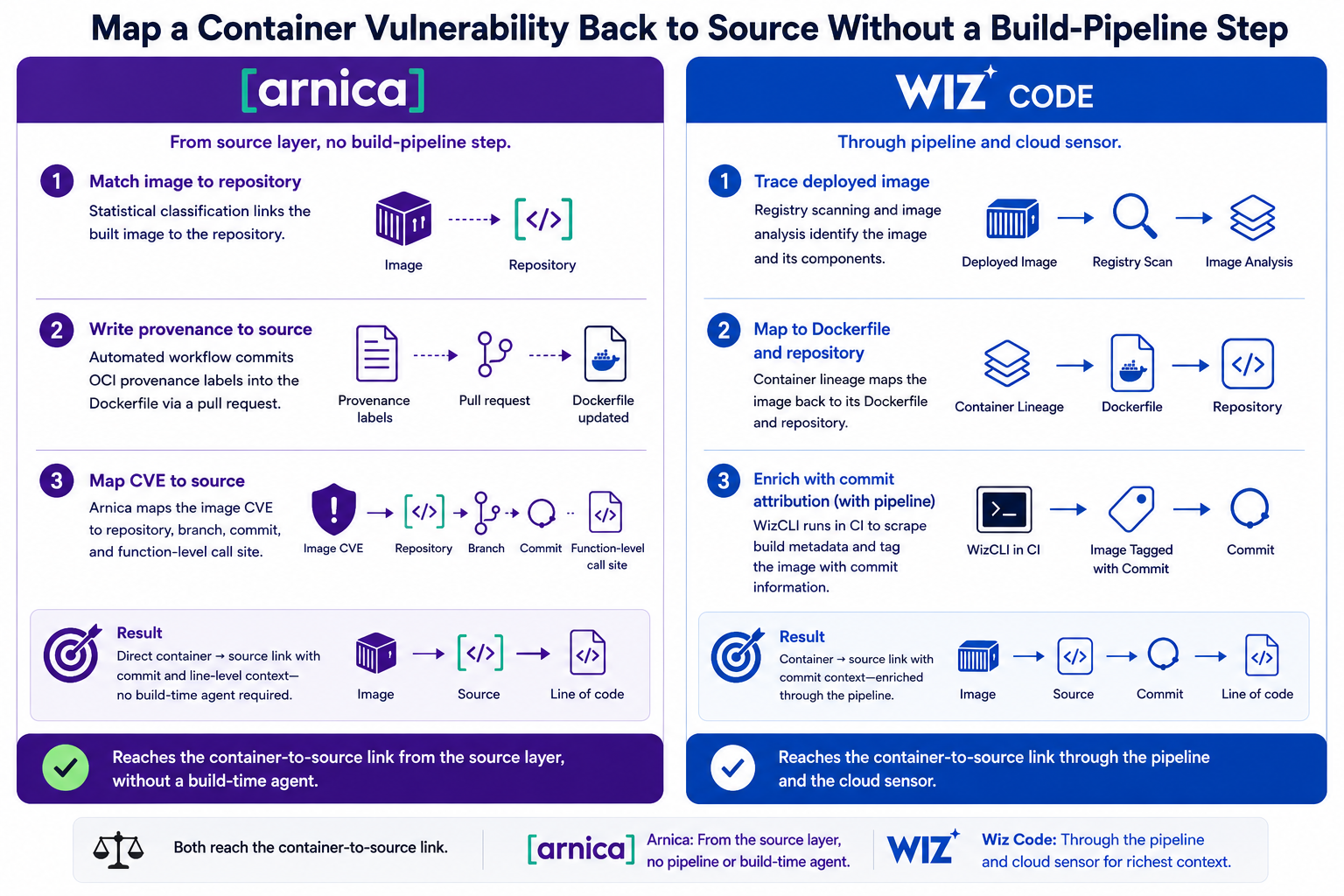
Map a container vulnerability back to source without a build-pipeline step
A container vulnerability is only actionable once a team knows which repository and commit built the image and which line of source uses the vulnerable package. Arnica establishes that link at the source-code layer with no pipeline step: statistical classification matches a built image to the repository that produces it, and an automated workflow commits OCI provenance labels into the Dockerfile by piggybacking on a pull request, so the provenance travels with every image the repository builds. Arnica then maps the image CVE to the repository, branch, and commit, and to the function-level call site in source.
Wiz Code traces a deployed image back to its Dockerfile and repository through registry scanning, image analysis, and container lineage, and enriches the link with commit-level attribution when WizCLI runs in the CI pipeline to scrape build metadata and tag the image. Both reach the container-to-source link; Arnica reaches it from the source layer without a build-time agent, and Wiz reaches its richest form through the pipeline and the cloud sensor.
Where Wiz Code is the stronger choice vs. Arnica
Wiz Code is part of a cloud-native platform, and that platform does things Arnica does not attempt. The Wiz sensor produces code-to-cloud runtime context, so Wiz can tell a team whether a vulnerable component is actually deployed, internet-exposed, or holding access to sensitive data, and correlate code findings with cloud misconfigurations, identities, and network exposure into a single attack path across the CNAPP.
Arnica prioritizes from the source-code and container layers and runs no cloud-runtime sensor. A buyer whose primary need is unifying code and cloud risk in one platform, and who already runs Wiz for cloud security, will get value from Wiz Code that a source-code-layer platform does not provide.
Other established alternatives to Wiz Code
For teams that want a broad standalone AppSec suite rather than a cloud-platform module, Snyk offers wide scanner coverage (SAST, SCA, container, IaC, and DAST) with a marketplace IDE (Integrated Development Environment) plugin and an agentic developer surface. Endor Labs is a common choice for teams whose top priority is function-level SCA reachability, and it integrates with Wiz directly.
Aikido is a developer-first all-in-one scanner aimed at smaller teams that want bundled coverage with light setup. Each is a different shape of platform, and a fuller comparison against Arnica lives on its own page.
FAQ
Is Wiz Code a standalone code security tool?
Wiz Code is the code-security module of the Wiz cloud platform. Its native scanners (SCA, secrets, IaC, and SAST) run against repositories through an SCM app, and its defining value, code-to-cloud correlation, depends on the Wiz cloud sensor seeing the deployed workload. It is generally bought alongside the broader Wiz platform under an enterprise agreement.
Does Wiz Code rewrite git history to remove a committed secret?
No. Wiz Code detects secrets across the full git history, validates whether the credential is still active, and delivers guidance to revoke and rotate it. The secret value remains in the repository’s history. Arnica rewrites the history to remove the secret and hands back a masked branch, then leaves rotation of the live credential to the customer’s secrets workflow.
Does Wiz Code govern AI coding agents before they generate code?
Wiz Code scans AI-generated code at the git lifecycle boundary (file save, pre-commit, pre-push) through a per-workstation or per-repository plugin and can block critical findings, and Wiz has described extending guardrails into the generation step as a roadmap direction. Arnica writes a managed rule pack into each agent’s own configuration file across 100% of connected repositories, so the policy is present in the agent’s generation context before code is written.
Can I use both Wiz Code and Arnica?
Yes. A common pattern is Wiz for cloud and code-to-cloud runtime context and Arnica for source-code-layer governance at generation, identity-aware routing, secret history-rewrite, and dynamic re-engagement. The two operate at different layers and the coverage overlaps only on the scanner basics.
How is Arnica priced compared to Wiz Code?
Arnica is priced per identity per year as a fixed line (Free, $300, or $600 per identity per year). Wiz prices on cloud workload volume with Wiz Code as an add-on, quoted under an enterprise agreement, so the code-security cost is bound to the broader cloud-platform contract.
Reduce Risk and Accelerate Velocity
Integrate Arnica ChatOps with your development workflow to eliminate risks before they ever reach production.