
Application Security Testing: SAST, DAST, and SCA Guide (July 2026)

Security testing tools for web applications have gotten a lot better, but the gap between running a scanner and actually covering your attack surface is still wide. Runtime application security testing examples look very different from static application security testing examples, and the DAST vs SAST debate misses the point if you treat it as either/or. The OWASP Top 10 requires all three major testing categories to cover properly. This is a practical look at how types of application security testing work together, what the best application security testing tools actually cover, and how to structure a program that keeps up with how fast your team ships.
TLDR:
- SAST catches code-level flaws at commit time; DAST finds runtime issues like auth bypass that static analysis cannot see. You need both.
- No single tool category covers the full OWASP Top 10. Broken Access Control, Vulnerable Components, and misconfigurations each require different testing methods.
- The minimum viable baseline: SAST and secrets scanning on every pull request, SCA on every dependency update, DAST on every pre-production deployment.
- Triage findings by exploitability and blast radius, and track mean time to remediate alongside detection rate to measure real program improvement.
- Arnica ranks AppSec findings by reachability and exploitability, and scans AI-generated and human-written code through the same pipeline.
What Is Application Security Testing
Application security testing is the practice of identifying, analyzing, and resolving security vulnerabilities in software before attackers can reach them. It spans everything from reviewing source code before a single line ships to probing a running application the way a real attacker would.
The stakes are straightforward: software vulnerabilities are the most common entry point for breaches, and catching them early costs a fraction of what remediation costs post-production. Arnica helps security and engineering teams find and fix those vulnerabilities without slowing down delivery.
Two methods anchor the field:
- Static application security testing (SAST) analyzes source code, bytecode, or binaries without executing the application, catching issues like hardcoded credentials or injection flaws at the code level.
- Runtime application security testing (DAST) tests a running application by simulating real attack traffic, exposing vulnerabilities that only appear at runtime.
Most programs layer both alongside software composition analysis (SCA) and interactive testing (IAST) to cover the full attack surface.
Types of Application Security Testing
There are several distinct approaches to finding vulnerabilities in software, each suited to different stages of the development lifecycle and different threat models.
Static Application Security Testing (SAST)
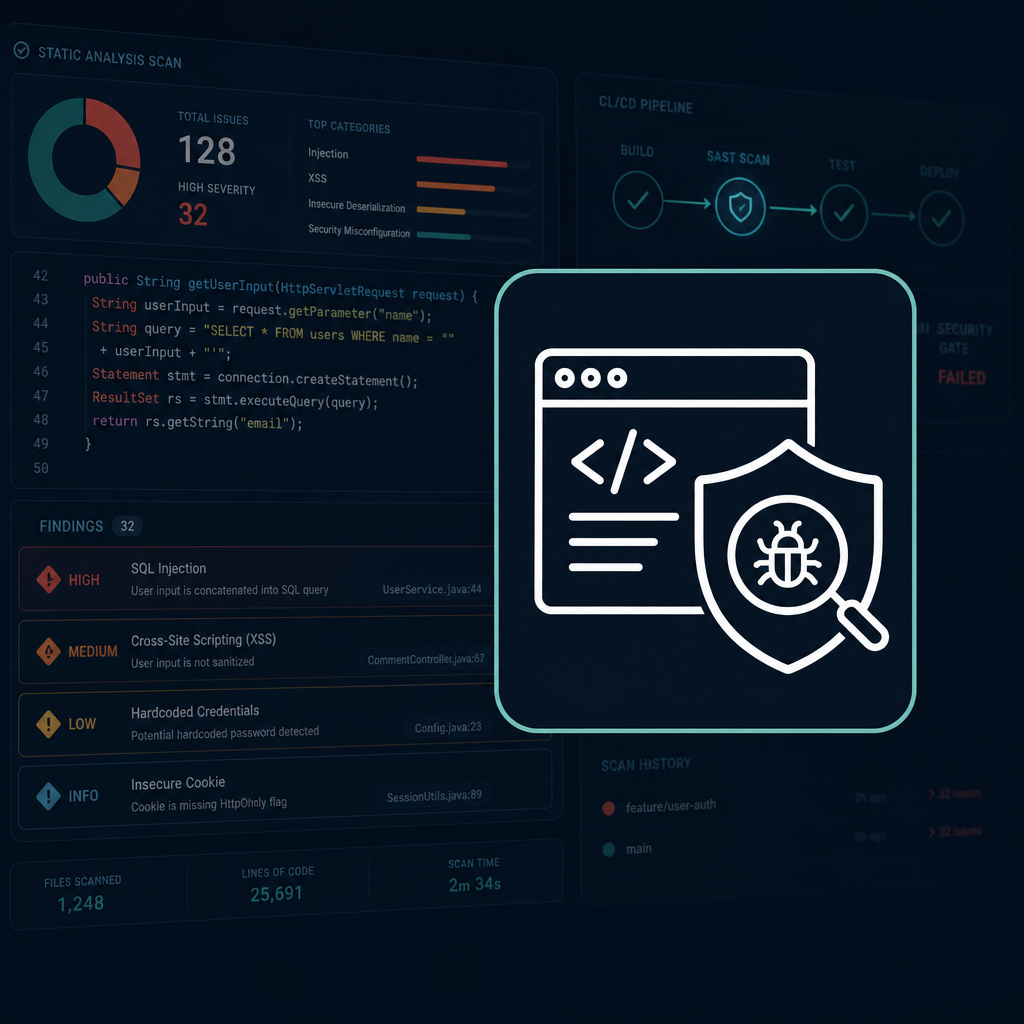
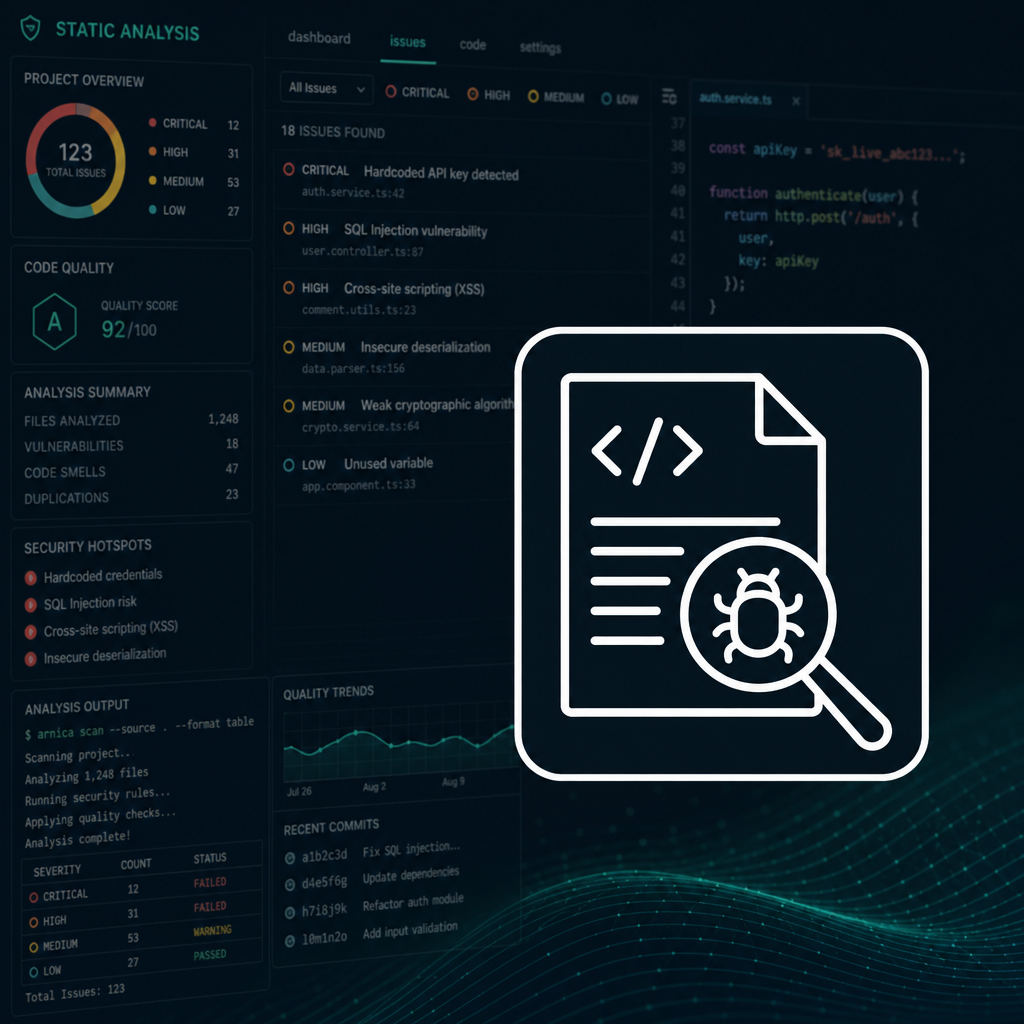
SAST analyzes source code, bytecode, or binary code without executing the application. It runs early in development, often inside the IDE or CI pipeline, and catches issues like hardcoded credentials, injection flaws, and insecure API usage before code ships.
Runtime Application Security Testing (DAST)
DAST tests a running application by simulating real attack traffic. It uncovers runtime vulnerabilities like authentication bypass and misconfigured headers that static analysis cannot see.
Software Composition Analysis (SCA)
SCA scans dependencies for known CVEs and license risks across open source packages.
Interactive Application Security Testing (IAST)
IAST instruments the application at runtime, combining the depth of SAST with the realism of DAST.
Static vs. Runtime Application Security Testing
Static application security testing (SAST) analyzes source code without executing it, catching vulnerabilities early in development. Runtime application security testing (DAST) tests a running application from the outside, simulating how an attacker would probe it in production.
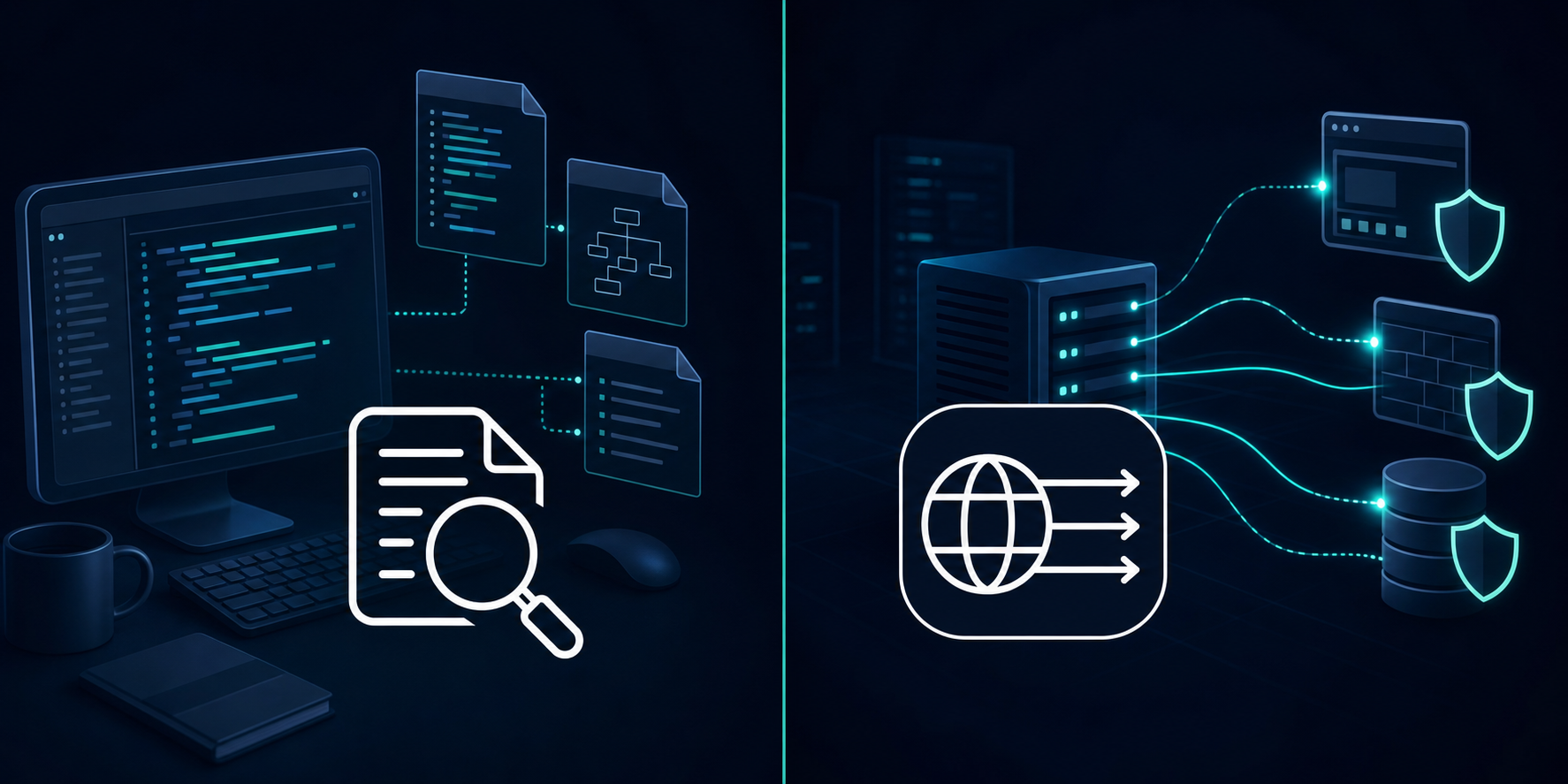
Both have real tradeoffs. SAST produces faster feedback but generates more false positives. DAST finds runtime issues SAST misses entirely, like authentication flaws and session misconfigurations, but requires a deployed environment to run. A SAST vs. DAST comparison is worth reviewing in depth.
Neither approach alone is sufficient. Most security teams run both in parallel, using SAST to catch code-level flaws early and DAST to validate behavior under real conditions before release.
Application Security Testing Tools
The market for application security testing tools spans a wide range, from open source scanners to commercial suites tracked in the Gartner Magic Quadrant for Application Security Testing. Picking the right one depends on your pipeline, your team's maturity, and the risk profile of what you're shipping.
Three categories cover most of what teams reach for:
- SAST tools analyze source code before it ever runs, catching injection flaws, hardcoded credentials, and logic errors at commit time.
- DAST tools probe a live application from the outside, simulating the requests an attacker would send to find runtime vulnerabilities SAST cannot see.
- SCA tools inventory open source dependencies and flag known CVEs before they reach production.
OWASP Top 10 and What It Means for AppSec Testing
The OWASP Top 10 is a regularly updated list of the most critical web application security risks, maintained by the Open Worldwide Application Security Project. It serves as a baseline reference for what AppSec testing programs should cover at minimum.
The 2021 edition reorganized priorities around real-world breach data. Broken Access Control climbed to the top spot, with Cryptographic Failures and Injection rounding out the top three. Security Misconfiguration, Vulnerable and Outdated Components, and Identification and Authentication Failures also made the list, reflecting how much attack surface now lives outside application code itself.
Here is how this shapes testing strategy:
- SAST tools are well-suited to catching injection flaws and hardcoded credentials before code ships, but they cannot detect misconfigurations in deployed infrastructure or outdated dependencies pulling in known CVEs.
- DAST tools exercise the running application and can surface broken access control issues and authentication weaknesses that static analysis misses entirely.
- Software Composition Analysis (SCA) is required to track Vulnerable and Outdated Components, which SAST and DAST both largely ignore.
No single tool category covers the full OWASP Top 10. Understanding the AppSec tools categories and coverage gaps makes those blind spots predictable and addressable.
Integrating AppSec Testing into the SDLC and CI/CD
Security testing that only runs before a release is a relic of waterfall development. In a CI/CD world, every commit is a potential attack surface, and decisions around CI/CD pipeline security vs. IDE plugins shape how each one is handled.
The goal is shifting security left without creating friction that slows engineering teams down.
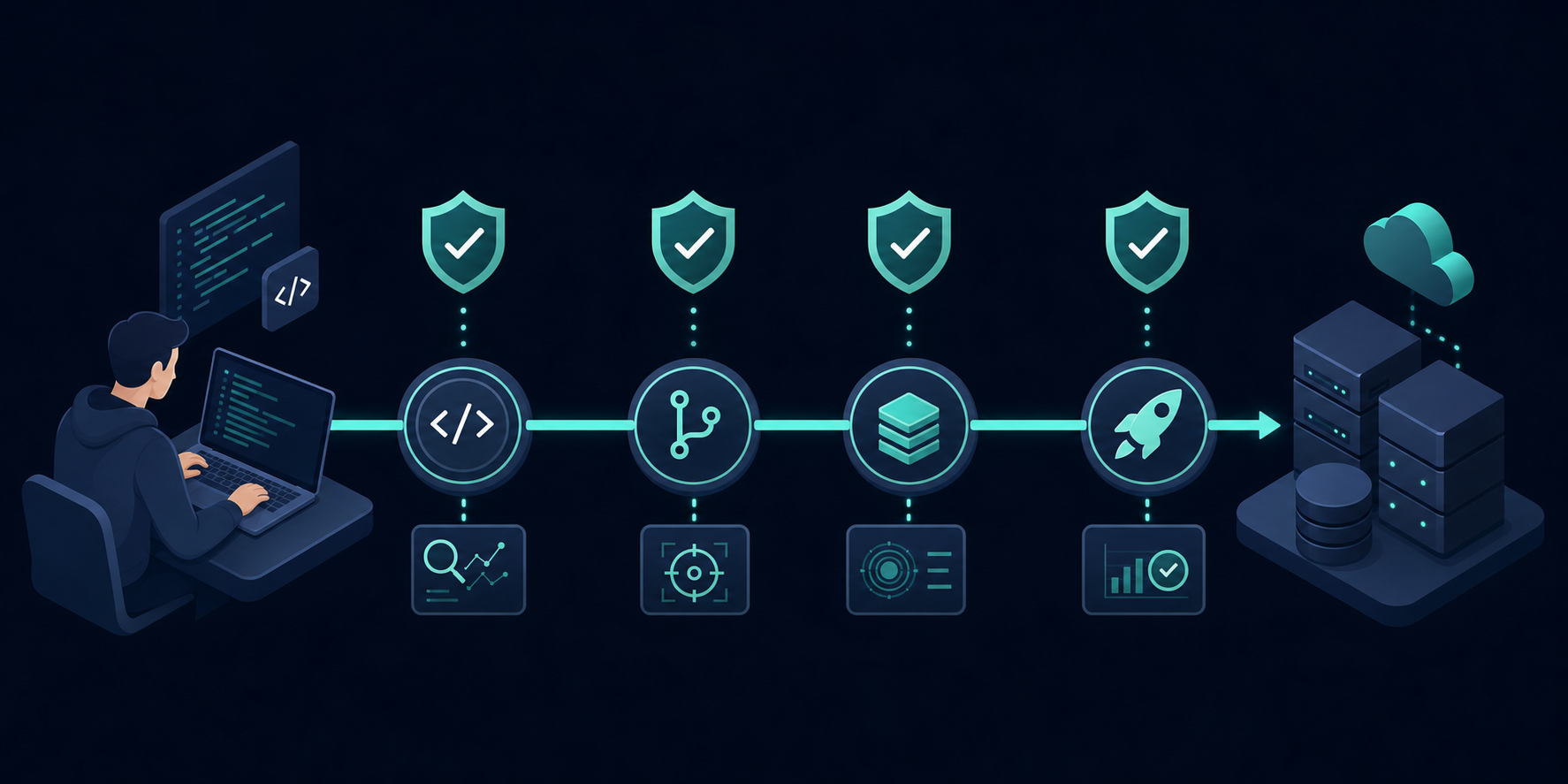
Where Testing Fits in the Pipeline
- SAST tools run at commit or pull request time, catching code-level vulnerabilities before they ever reach a staging environment.
- Understanding SCA and SAST together helps here: SCA scans trigger on dependency changes, flagging vulnerable or malicious packages the moment they enter the build graph.
- DAST runs against deployed staging or pre-production environments, testing the running application the way an attacker would.
- Secrets detection gates every push, preventing credentials from reaching version control at all.
Making It Stick
The tests that get skipped are the ones that block without explaining. Security tooling integrated into CI/CD needs to return actionable, contextual findings with enough detail for a developer to fix the issue without escalating to the security team. Scan results that surface as vague policy violations get dismissed. This is where AI-powered SAST tools for reducing false positives make a difference: results that include the vulnerable code path, the exploitability context, and a suggested fix get resolved.
The minimum viable baseline: SAST and secrets scanning on every pull request, SCA on every dependency update, and DAST on every pre-production deployment.
AppSec Testing Best Practices
Effective appsec testing requires more than running a scanner. The teams that catch vulnerabilities before production share a few consistent habits.
There are several practices worth building into your process:
- Shift security left by integrating SAST into your CI/CD pipeline so developers get feedback at the point of code commit, not weeks later during a standalone audit.
- Run DAST against staging environments that closely mirror production, since testing against a stripped-down environment produces results that won't reflect real attack surface.
- Treat findings as a backlog, not a report. Triage by exploitability and blast radius, not by severity score alone.
- Retest after every remediation to confirm the fix closed the vulnerability and did not merely suppress the symptom.
- Track mean time to remediate alongside detection rate so you can measure whether your program is actually improving.
The minimum viable baseline: SAST running on every pull request, DAST scheduled weekly against staging, and SCA scanning every dependency update. Reviewing the top AppSec tools in 2026 can help you fill each slot. Anything below that leaves gaps an attacker will find before you do.
The Gartner Magic Quadrant for Application Security Testing
Gartner's Magic Quadrant for Application Security Testing is one of the most referenced analyst reports in the appsec space. It scores vendors across two axes: completeness of vision and ability to execute, grouping them into four quadrants (Leaders, Challengers, Visionaries, and Niche Players).
The report covers vendors offering SAST, DAST, IAST, SCA, and API security testing capabilities. Leaders in the 2024 edition included Checkmarx, Veracode, Synopsys, and OpenText. These vendors tend to offer broad testing coverage across multiple AST categories, though developer-centric security testing for DevSecOps requires measuring depth, not breadth alone.
For buyers, the Magic Quadrant is a useful starting point, but quadrant placement alone should not drive purchasing decisions. A tool positioned as a Niche Player may outperform a Leader on your specific stack, language support, or CI/CD integration requirements.
How Arnica Approaches AppSec Testing for the Agentic Era
Arnica takes a developer-first approach to AppSec testing, embedding security checks directly into the workflows engineers already use, not bolting them on after code ships.
Where traditional tools surface long vulnerability backlogs with little context, Arnica ties findings to code ownership, risk signals, and business criticality so security teams can act on what actually matters. Prioritization is based on reachability and exploitability, not raw vulnerability counts.
Arnica also accounts for the agentic era directly, where AI SAST tools are increasingly critical. As AI-generated code enters production at scale, the attack surface grows faster than manual review cycles can keep up with. Arnica scans AI-generated and human-written code through the same pipeline, using multi-file AI SAST to catch vulnerabilities single-file scanners miss, without requiring separate configurations or tooling.
Final Thoughts on Static and Runtime Application Security Testing
SAST and DAST are both worth running, and the gap between them is where SCA and runtime testing fill in. Your testing program does not need to be perfect from day one, but it does need to cover the basics consistently across every pull request and deployment. Try Arnica to see how security checks can fit into the workflows your engineering team already uses. Consistent coverage beats occasional perfection.
FAQ
What is the difference between DAST and SAST in application security testing?
SAST analyzes source code without executing it, catching injection flaws, hardcoded credentials, and insecure API usage at commit time. DAST tests a running application by simulating real attack traffic, surfacing runtime vulnerabilities like authentication bypass and session misconfigurations that static analysis cannot reach. Most security teams run both: SAST for early code-level feedback, DAST to validate behavior against a deployed environment before release.
How do I integrate SAST and DAST tools into a CI/CD pipeline without slowing down engineering?
Connect SAST to your pull request workflow so developers get findings at commit time, not weeks later in a standalone audit. Run SCA on every dependency update, trigger DAST against a staging environment that mirrors production on every pre-production deployment, and gate every push with secrets detection. The tests that get skipped are the ones that block without explaining. Findings need to include the vulnerable code path, exploitability context, and a suggested fix, not a bare policy violation label.
Which application security testing tools appear in the Gartner Magic Quadrant for Application Security Testing, and how should I use that list?
Checkmarx, Veracode, Synopsys, and OpenText have appeared as Leaders in the 2024 Gartner Magic Quadrant for Application Security Testing, ranked on completeness of vision and ability to execute across SAST, DAST, IAST, SCA, and API security. The Magic Quadrant is a useful starting point, but quadrant placement alone should not drive purchasing decisions. A Niche Player may outperform a Leader on your specific stack, language support, or CI/CD integration requirements.
Does any single appsec testing tool cover the full OWASP Top 10?
No single tool category covers the full OWASP Top 10. SAST tools catch injection flaws and hardcoded credentials but cannot detect misconfigurations in deployed infrastructure or outdated dependencies carrying known CVEs. DAST surfaces broken access control and authentication weaknesses that static analysis misses. SCA is required to track Vulnerable and Outdated Components. A testing program anchored on one approach will have documented, predictable blind spots that map directly to OWASP categories the chosen tool does not reach.
What appsec testing approach works for AI-generated code at scale?
AI-generated code needs to move through the same scanning pipeline as human-written code, without separate configurations or tooling. The volume problem is real: AI coding agents produce code faster than manual review cycles can keep up with, which means SAST, SCA, and secrets detection need to trigger on every push and pull request regardless of whether a human or an agent authored the commit. Arnica scans AI-generated and human-written code through the same pipeline and ties findings to code ownership and exploitability signals so security teams act on what matters and skip managing raw vulnerability counts.
Reduce Risk and Accelerate Velocity
Integrate Arnica ChatOps with your development workflow to eliminate risks before they ever reach production.