
The AppSec Tools Landscape in 2026: Categories, Overlap, and Gaps

When your AppSec program uses more than five application security tools, you're not building defense in depth. You're managing alert fatigue. SAST scans code, DAST tests runtime behavior, SCA monitors dependencies, secrets detection stops credential leaks, and somewhere in your stack there's an ASPM layer trying to make sense of the noise. The appsec tools market has expanded sharply in 2026 because everyone kept adding scanners without asking whether they actually worked together. Let's walk through what each category does, where the overlap creates noise, and where the gaps leave you exposed.
TLDR:
- AppSec tools cover five core categories (SAST, DAST, SCA, IAST, Secrets Detection), each catching different risks at different stages, and no single category provides complete coverage.
- The average enterprise runs 130+ security tools, driving consolidation, but bundled suites often sacrifice depth for convenience.
- ASPM aggregates findings across silos and ranks them based on business context, like whether code is live or who owns the asset.
- AI-generated code now flows through most development workflows, but traditional tools weren't built to reason about provenance or the speed of agentic pipelines.
- Arnica monitors activity continuously across your SCM pre-pipeline, catching risky patterns, secrets, and AI code governance issues before PRs open.
What Application Security Tools Are and Why They Matter
Application security tools are software solutions designed to find, track, and fix security vulnerabilities in code, dependencies, infrastructure configs, and developer workflows. They sit between the moment a developer writes code and the moment that code runs in production, catching problems before they become incidents.
The stakes are real. The average data breach cost $4.88 million, with software vulnerabilities among the most common root causes. Security teams that lack proper tooling often find out about vulnerabilities the hard way.
AppSec tools matter because software is now the primary attack surface for most organizations. Every API endpoint, every third-party package, every hardcoded secret is a potential entry point.
The Core Categories: SAST, DAST, SCA, IAST, and Secrets Detection
The five categories below are the building blocks of most AppSec programs. Each operates at a different point in the development lifecycle, catches a different class of risk, and has real gaps when used in isolation.
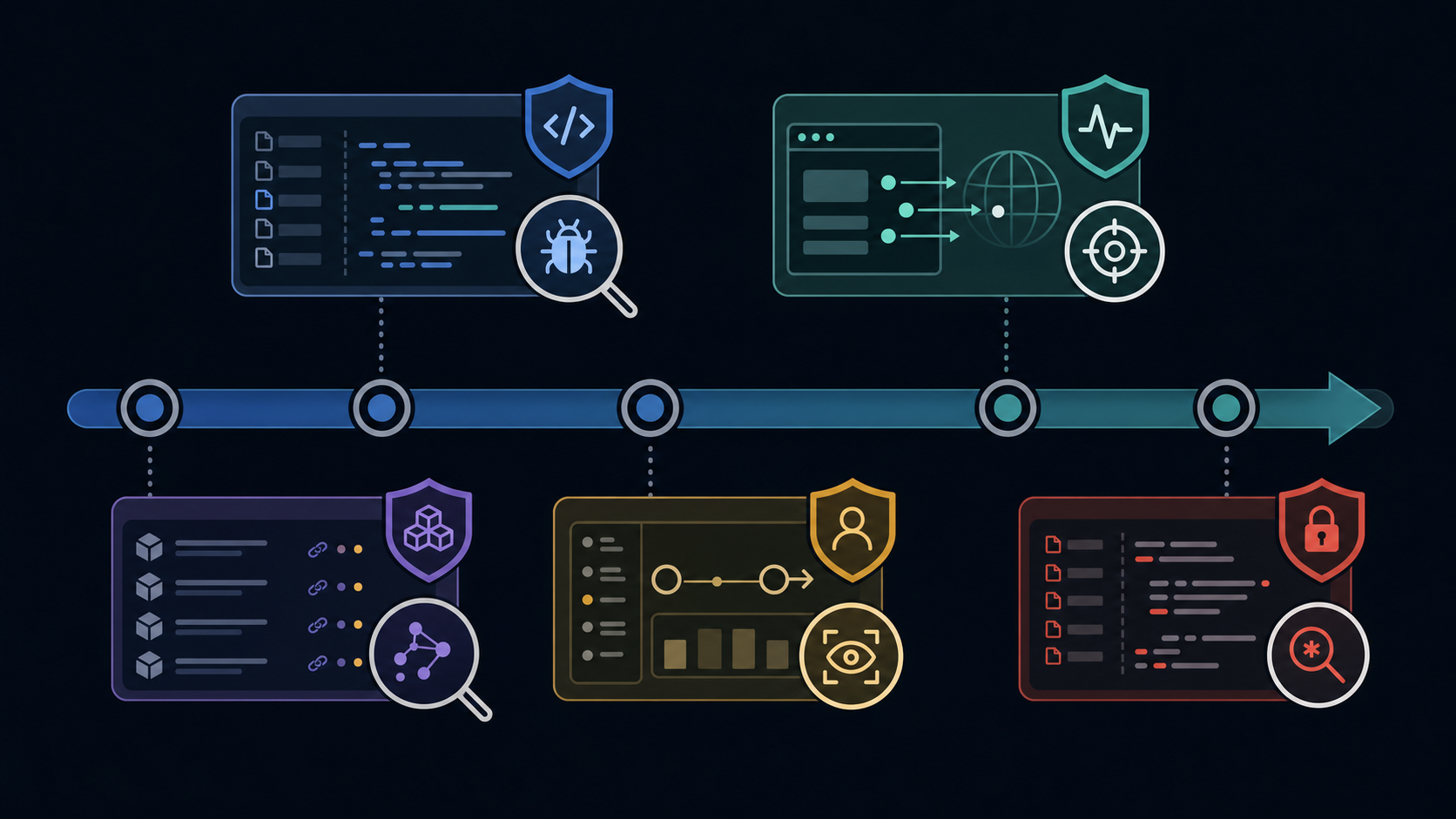
| Category | When It Runs | What It Catches |
|---|---|---|
| SAST | Pre-deployment, against source code | Injection flaws, insecure patterns, hardcoded values, logic errors |
| DAST | Against a running application | XSS, auth bypass, runtime misconfigurations, API exposure |
| SCA | Any stage, on dependency manifests | Known CVEs in third-party packages, license violations, outdated libraries |
| IAST | During runtime testing or QA | Code-level vulnerabilities confirmed by actual request flows |
| Secrets Detection | On repo history and current branches | Hardcoded credentials, API keys, tokens, connection strings |
No single category covers the full surface. SAST catches what it can see in source but misses runtime behavior entirely. DAST finds what SAST can't, though it requires a running environment and tends to generate noise. SCA keeps your dependencies clean without touching your own code. IAST adds context by instrumenting live apps, but only during active test runs. Secrets detection is narrowly scoped, yet it catches one of the most consistently dangerous mistakes teams make.
Market Growth and Adoption Patterns Across 2025 and 2026
The appsec tools market grew at a strong double-digit compound annual rate through 2025, and analysts across multiple firms project continued double-digit growth through 2026 and beyond.
Adoption patterns tell an equally telling story. Security teams expanded their toolsets faster than their headcount, creating a ratio problem: more tools, same number of engineers to run them. The average enterprise AppSec program now manages seven or more distinct appsec tools across testing, scanning, and runtime categories.
Tool Sprawl and the Consolidation Movement
Enterprises today run security tools across dozens of overlapping categories and consoles. Security teams are drowning in alerts, context-switching between consoles, and struggling to connect findings across tools that were never designed to talk to each other.
That friction is driving consolidation. CISOs are actively reducing vendor count, pushing toward fewer, deeper integrations over broader, shallower coverage. The appeal is real: fewer handoffs, less noise, and cleaner accountability.
But consolidation has a cost. When tools bundle features to win deals, depth often suffers. A SAST module inside a security suite rarely matches a purpose-built SAST engine. Teams end up with coverage that looks complete on a vendor slide and falls short in practice.
The real question is whether you're consolidating around actual capability or just around contracts.
Application Security Posture Management: The New Orchestration Layer
Application Security Posture Management (ASPM) has become the connective tissue holding the appsec tools ecosystem together. Where traditional tools operate in silos, ASPM aggregates findings across SAST, DAST, SCA, secrets scanning, and more, then normalizes and ranks them in a unified view.
The value is context. A critical SAST finding in dead code is a lower priority than a medium-severity secret exposed in an actively deployed service. ASPM tools apply that logic at scale.
Key capabilities that define mature ASPM solutions include:
- Connecting findings across multiple scanners to reduce duplicate noise and identify what actually matters
- Mapping vulnerabilities to business context, such as asset ownership, exposure, and code reachability
- Tracking remediation workflows so security debt doesn't quietly accumulate
- Feeding risk signals back into developer workflows without requiring engineers to leave their tools
ASPM sits above the individual scanning categories and is increasingly where AppSec teams spend their time managing program-level risk instead of triaging raw scanner output.
Where Tools Overlap and Where Gaps Still Exist
Tool categories in AppSec rarely stay in their lanes. SAST and SCA both scan code repositories. DAST and API security testing both probe running endpoints. Secrets detection overlaps with SAST when scanners flag hardcoded credentials. The result is duplicated findings, alert fatigue, and security teams spending more time deduplicating tool outputs than fixing vulnerabilities.
The gaps are just as telling. Most tools still operate in silos, with no shared context between what a SAST scan found and what a runtime tool observed. Supply chain risk sits in a blind spot between SCA and cloud security. Developer behavior, such as who is pushing risky code and when, rarely factors into any tool's risk scoring.
AI Code Security and the Agentic Development Challenge
AI-generated code has gone from novelty to default in under three years. Most development teams now use some form of AI coding assistant, and agentic systems that write, test, and commit code autonomously are no longer experimental.
The security gap this creates is real. AI-generated code carries the same vulnerability classes as human-written code, and sometimes more, because models trained on public repositories inherit the insecure patterns baked into that training data. Traditional appsec tools were built assuming a human wrote every line.
That assumption no longer holds.
Existing SAST and SCA tools can scan AI-generated code, but they weren't designed to reason about provenance, generation context, or the speed at which agentic pipelines produce and merge changes.
How to Choose Tools: Evaluation Criteria That Actually Matter
Three factors separate tools that hold up at scale from those that create new blind spots.
- How early in the SDLC they can run: tools that only operate post-deployment catch risk too late to be cost-effective to fix.
- Whether they produce actionable findings or just noise: high false-positive rates erode developer trust fast, and a tool that cries wolf gets ignored.
- How well they integrate with existing workflows: security that requires developers to leave their IDE or break their CI/CD pipeline will be bypassed.
Beyond those basics, measure coverage against your actual risk profile. A team shipping containerized microservices needs strong SCA and IaC scanning. A team building APIs needs runtime protection and secrets detection.
Consolidation matters too. Fewer tools mean fewer alert queues, fewer integrations to maintain, and less context-switching for already-stretched security teams.
How Arnica Governs the Agentic Development Lifecycle
Arnica governs agentic development security by connecting the dots across the entire software delivery lifecycle, from the moment a developer writes code to the point it ships. Where most appsec tools focus on a single stage, Arnica governs the full chain: who is writing code, what AI tools they're using, what that code contains, and where it ends up.
The core of Arnica's approach is pipelineless security. Instead of waiting for a CI/CD trigger, Arnica monitors activity continuously across your SCM, detecting risky code patterns, secrets, and anomalous developer behavior in real time. Findings surface before a pull request is even opened.
Arnica also manages AI code governance directly, giving security teams visibility into AI-generated code contributions and the ability to set policy around them.
Final Thoughts on Application Security Tooling
The appsec tools market keeps expanding, but more coverage doesn't always mean better security. What matters is whether your tools catch risk early enough to fix it cheaply and whether they work with how your developers actually write and ship code. See how Arnica works across your SCM without waiting for pipeline triggers. Security should be continuous, not conditional.
FAQ
What's the difference between SAST and DAST for finding vulnerabilities?
SAST scans source code before deployment and catches injection flaws, insecure patterns, and logic errors in the codebase itself, while DAST tests running applications to find XSS, authentication bypass, and runtime misconfigurations. SAST sees what's written but misses runtime behavior; DAST confirms what actually happens when the application runs but requires a live environment and often generates noise.
Can appsec tools detect vulnerabilities in AI-generated code?
Yes, but most tools weren't built for the speed and volume at which agentic systems produce code. Traditional SAST and SCA tools can scan AI-generated code for the same vulnerability classes they find in human-written code, but they don't reason about generation context, provenance, or the workflow differences when an autonomous agent writes, tests, and commits changes without human review.
How do I choose between consolidating appsec tools versus keeping specialized ones?
Assess whether you're consolidating around actual capability or just around contracts. Fewer tools mean less context-switching and cleaner accountability, but bundled features in security suites rarely match the depth of purpose-built engines. Run the tools against your actual codebase and measure false-positive rates, coverage gaps, and how well they integrate with your existing workflows before committing to consolidation.
What is ASPM and why does it matter for appsec programs?
ASPM (Application Security Posture Management) aggregates findings across your SAST, DAST, SCA, and secrets scanning tools, then normalizes and ranks them in a unified view. It applies business context so you can tell the difference between a critical SAST finding in dead code and a medium-severity secret exposed in an actively deployed service, which matters because security teams are drowning in alerts from seven or more tools that don't talk to each other.
Arnica vs traditional appsec tools for agentic development?
Arnica governs the full agentic development lifecycle by monitoring activity continuously across your SCM without waiting for CI/CD triggers, managing AI code governance directly with policy controls around AI-generated contributions, and surfacing findings before a pull request is opened. Traditional appsec tools operate at specific lifecycle stages and weren't designed to handle the provenance, generation context, or merge speed of agentic pipelines.
Reduce Risk and Accelerate Velocity
Integrate Arnica ChatOps with your development workflow to eliminate risks before they ever reach production.