

Your AppSec tool should tell you which findings matter most, who owns them, and what to do next. Whether Checkmarx or Arnica gets you there depends a lot on how your security and engineering teams actually work together, and what your threat model looks like beyond traditional CVE scanning.
TLDR:
- Checkmarx One covers SAST, SCA, IaC, and secrets detection across 30+ languages, built for compliance-driven enterprise AppSec programs
- The key difference is prioritization: Checkmarx scores by CVSS severity, while context-aware tools factor in reachability, code ownership, and pipeline exposure
- In Arnica's analysis of customer repositories, 82% of findings belong to developers no longer at the company, making identity-aware routing a real workflow gap
- Agentic AI governance is a new dividing line: most AppSec tools scan AI-generated code but do not govern autonomous pipeline actions
- Arnica covers SAST, SCA, secrets detection, IaC, SBOM, and ASPM with supply chain identity context built in from the start
What Is Checkmarx One?
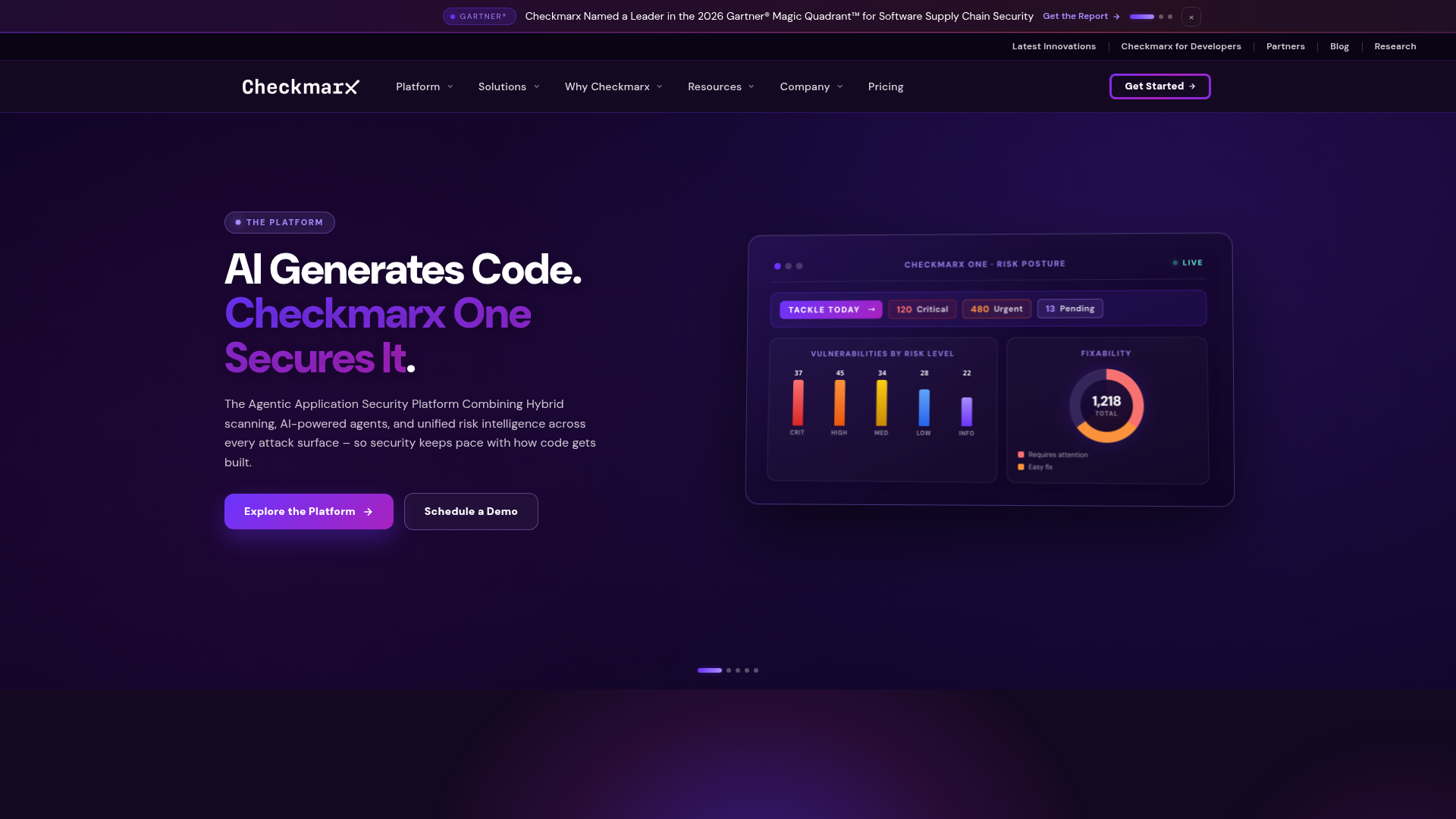
Checkmarx One is an application security testing suite built around static analysis (SAST), software composition analysis (SCA), and API security scanning. It has been a fixture in enterprise application security tools programs for years, particularly among organizations that run large-scale code scanning across multiple languages and frameworks.
The product has expanded over time to include secrets detection, IaC security, and a supply chain security module. Checkmarx positions these capabilities under a unified console, though teams frequently report that the integrations between modules feel bolted together instead of purpose-built to share context.
Where Checkmarx One is strongest is in raw scanning breadth. It covers over 30 languages and supports a wide range of CI/CD integrations. For organizations that need audit-ready reports and checkbox compliance coverage, it delivers.
The trade-off is alert volume and remediation friction. Security teams working in Checkmarx often face high false-positive rates and limited workflow automation, which pushes triage burden onto already stretched AppSec engineers. There is no native developer risk scoring tied to code behavior or identity context, and prioritization relies heavily on CVSS severity over actual exploitability in your environment.
What Is Arnica?
Arnica is an application security and software supply chain security company built for engineering-speed organizations. Where legacy AppSec tools bolt security onto the end of the development cycle, Arnica integrates directly into the developer workflow, surfacing risk where code is actually written and reviewed.
The product covers SAST, SCA, secrets detection, IaC security, SBOM generation, and application security posture management in a single connected experience. Risk signals are unified across the software supply chain so security teams get context, not a raw list of findings.
Arnica is designed for CISOs and AppSec leads who need coverage without slowing down engineering.
ASPM and Risk Prioritization
Checkmarx offers application risk management through its AppSec posture management layer, which aggregates findings from SAST, SCA, and other testing tools into a unified risk view. It maps vulnerabilities to business context and supports prioritization through risk scoring. For teams already embedded in the Checkmarx suite, this correlation can reduce time spent triaging raw scan output.
Arnica approaches risk prioritization differently. Scoring vulnerabilities in isolation misses the point: it factors in real developer behavior, code ownership, repository exposure, and pipeline configuration to produce contextual risk signals. A critical CVE in a library that is never loaded in production ranks differently than one in a package actively called by a customer-facing service. That distinction matters when your team is working through hundreds of findings per sprint.
Arnica also surfaces developer risk posture, flagging things like overprivileged identities, leaked secrets in commit history, and risky pipeline permissions that sit outside traditional vulnerability scoring models entirely. This gives AppSec teams a broader picture of where risk actually lives across the software supply chain, going beyond the narrow view of where scanners fire.
Scanning Coverage: SAST, SCA, IaC, and Secrets
Both tools cover the core AppSec scanning categories: SAST, SCA, IaC security, and secrets detection. The differences show up in depth and what happens after a finding is surfaced.
SAST
Checkmarx SAST supports over 30 languages with deep data flow and taint tracking. Security teams often cite high false positive rates as an ongoing management burden. Arnica SAST surfaces findings with enough context that developers can act without needing a security engineer to interpret results first.
SCA
Checkmarx SCA scans open-source dependencies for known CVEs and includes reachability analysis to filter by whether vulnerable code paths are called at runtime. Arnica SCA pairs dependency scanning with supply chain risk signals including package reputation scoring and maintainer risk factors, giving teams a fuller picture of third-party exposure beyond CVE presence alone.
IaC Security
Both tools scan Terraform, CloudFormation, and Kubernetes manifests for misconfigurations. Checkmarx IaC scanning is typically bundled into its broader SAST or ASPM tiers.
Secrets Detection
Arnica scans for hardcoded secrets across code, commit history, and pipeline configurations. When a secret is confirmed, Arnica auto-rewrites git history to remove the exposure, masks the affected branch, and hands the developer a single sync command to finish the cleanup. Findings are connected to developer identities and repo access patterns throughout. Checkmarx offers secrets detection at the file scan level with remediation guidance, but does not automate git history rewriting.
Agentic AI Governance
Agentic AI is moving fast, and most AppSec tool categories were not built to govern it. When AI agents write code, open pull requests, and trigger pipeline actions autonomously, the attack surface expands in ways that static scanning alone cannot track.
Arnica treats agentic activity as a first-class risk category. The Agentic Rules Enforcer writes governed rules directly into the config files every coding agent already reads (Cursor, Copilot, Claude Code, Gemini, Augment) across all connected repos, delivered through the same SCM connection the organization already has. No per-developer install is needed. Every AI-generated commit is attributed, every autonomous action is logged, and policy controls can gate or block agent behavior before it reaches production.
Checkmarx's Developer Assist enforces policy inside the IDE and scans AI-generated code for vulnerabilities. The trade-off is adoption: Developer Assist requires the extension installed per developer, per IDE (VS Code, JetBrains, Cursor, Windsurf). Coverage tops out at whatever percentage of workstations are actually provisioned, which is the same ceiling every IDE-plugin model has always had.
Developer Workflow and Remediation
Checkmarx routes findings back to developers through IDE plugins and pull request annotations, giving engineers in-context guidance without leaving their workflow. The feedback loop is useful, but the remediation experience still asks developers to act on individual findings instead of ordering work by business risk.
Arnica takes a risk-scored approach. Every finding is ranked by exploitability, reachability, and the sensitivity of the affected code, so developers see the highest-impact issues first. Fixes are suggested inline, and where Arnica's agentic capabilities apply, remediation can be triggered automatically without waiting for a developer to pick up the ticket. In practice, 92% of risks are resolved before reaching production and 78% are resolved before the merge request closes, with 100% code coverage from the moment Arnica connects to your SCM.
Software Supply Chain Security
Checkmarx covers supply chain risk through its SCA module, which scans open-source dependencies for known CVEs and license issues. It identifies vulnerable packages, maps them to fix versions, and flags license conflicts. That is useful baseline coverage, but it stops at the dependency layer.
Arnica approaches software supply chain security more broadly. It monitors identity and access across your SCM, CI/CD, and registries, catching risks like overprivileged service accounts, stale tokens, and misconfigured pipeline permissions before they become entry points. NIST SP 800-204d's guidance on CI/CD pipeline security identifies insecure access configurations as a primary attack vector, which is exactly the class of risk SCA-only tools miss. A compromised bot account with write access to your main branch is a supply chain risk. Arnica sees it; SCA alone does not.
One documented data point on supply chain risk: in spring 2026, Checkmarx confirmed that its own KICS Docker images and two GitHub Actions workflows were compromised in a supply chain attack, with data subsequently posted to a leak site. Checkmarx has published ongoing security updates on the incident; coverage also appeared in SecurityWeek and The Hacker News. For teams assessing AppSec vendors, it is worth reviewing how a vendor's own supply chain posture has changed since any such incident.
Identity-Aware Routing and Finding Ownership
Checkmarx routes findings through git author email, IDE notifications, and Jira tickets. When the original commit author has left or a commit came from a cloud agent bot identity, routing falls back to a repository owner or team alias, often a group inbox nobody actively monitors.
Arnica's identity graph maps SCM identity, Slack and Teams handles, and agent-bot identity to one resolved human, updated continuously from real repository activity. Per Arnica's analysis of customer repositories, 82% of findings belong to developers no longer at the company. When that happens, Arnica routes to a product-level security champion: a developer currently active in the relevant codebase who can actually fix and merge the change. Cloud agent commits get re-attributed to the human who dispatched the agent, so bot-authored code still has a real owner on the other end.
Pricing and Deployment Model
Checkmarx follows an enterprise licensing model with pricing negotiated through sales. Contracts typically run multi-year, with costs tied to the number of developers, repositories, or scan volumes. Public pricing is not available, and seats can add up quickly at scale.
Arnica's pricing is published and transparent: plans start free and scale to $300 or $600 per identity per year, based on actual developer activity. Deployment is cloud-native by default, with on-premises options available for organizations with strict data residency requirements.
Both products support SSO, role-based access controls, and API-based integrations into existing CI/CD workflows.
| Capability | Checkmarx One | Arnica |
|---|---|---|
| SAST | 30+ languages, deep data flow and taint tracking; high false-positive rates reported in practice | Major enterprise languages; context-aware findings developers can act on without a security engineer to interpret |
| SCA | CVE scanning with reachability analysis; dependency and license coverage | Dependency scanning plus supply chain risk signals: package reputation scoring and maintainer risk factors beyond CVE presence |
| IaC Security | Terraform, CloudFormation, Kubernetes; bundled into SAST or ASPM tiers | Terraform, CloudFormation, Kubernetes; integrated with the same risk-scoring and routing layer |
| Secrets Detection | File-level scan with remediation guidance; no automated git history rewrite | Scans code, commit history, and pipeline configs; auto-rewrites git history on confirmed secrets, masks branch, provides a sync command; connects findings to developer identities and repo access patterns |
| SBOM | Available via SCA module | Continuous SBOM; maps to container images and satisfies EO 14028, FDA, and NIST SP 800-218 requirements |
| ASPM / Risk Prioritization | CVSS-based scoring; aggregates findings from scanning modules | Factors in reachability, code ownership, repository exposure, and pipeline config; scores by actual exploitability in your environment |
| Agentic AI Governance | Developer Assist enforces policy inside the IDE and scans AI-generated code; requires extension installed per developer, per IDE (VS Code, JetBrains, Cursor, Windsurf) | Agentic Rules Enforcer writes governed rules into every agent's config file (Cursor, Copilot, Claude Code, Gemini, Augment) via SCM connection; attributes every AI-generated commit; gates or blocks agent behavior before production; no per-developer install required |
| Identity-Aware Routing | Routes via git author email; falls back to repo owner or team alias when the original author has left | Identity graph maps SCM, Slack/Teams, and agent-bot identities to one resolved human; routes to a security champion when the original author is no longer active |
| Developer Workflow | IDE plugins and PR annotations; findings ordered by severity, not business risk | Risk-scored findings ordered by exploitability and code sensitivity; inline fix suggestions; agentic auto-remediation where applicable |
| Supply Chain Security | SCA-level dependency coverage: CVE and license scanning | Monitors identity and access across SCM, CI/CD, and registries; catches overprivileged accounts, stale tokens, and misconfigured pipeline permissions |
| Deployment Model | Cloud or on-premises; requires CI/CD pipeline configuration for scan execution | Cloud-native by default; on-premises available; pipelineless architecture delivers 100% repo coverage from day one without pipeline setup |
| Best Fit | Compliance-driven enterprises with centralized AppSec programs and audit-ready reporting requirements | Engineering-speed organizations where security and engineering are tightly coupled and the threat model includes software supply chain risk |
Which Tool Should You Choose?
Choosing between Arnica and Checkmarx comes down to where your team sits organizationally and what you need security to do for you.
Checkmarx is a strong fit if your organization runs a traditional AppSec program built around scheduled scans, compliance reporting, and a centralized security team that owns remediation. Its depth in SAST and the breadth of its enterprise integrations make it a defensible choice for compliance-driven industries where audit trails and policy enforcement are the primary success metrics.
Arnica is the better fit if your engineering and security teams are tightly coupled, your threat model includes the software supply chain, and you need risk to surface where developers already work. Arnica's pipelineless architecture catches risk before code is committed, its developer-native workflow keeps friction low, and its ASPM layer gives AppSec leaders a unified view across SAST, SCA, secrets detection, IaC security, and SBOM without requiring full CI/CD coverage as a prerequisite.
One gap worth naming: Checkmarx ships DAST natively; Arnica does not. If runtime application security testing is a top-three requirement, Arnica pairs well with a dedicated DAST vendor but does not cover that category itself. Three additional questions can sharpen the rest of the decision:
- Do you need findings to reach developers in pull requests without waiting for pipeline execution? Arnica's pre-commit and IDE-level detection handles this natively; Checkmarx relies on pipeline triggers.
- Is software supply chain risk, including open-source dependency integrity and secrets sprawl, a first-class concern? Arnica was built with that scope in mind from the start.
- Does your security team measure success by audit reports or by reduction in risk at the point of code creation? The answer tells you which product's measurement model will actually serve your goals.
Final Thoughts on Picking the Right AppSec Tool
Neither tool is the wrong answer in a vacuum. Checkmarx works well for teams built around centralized AppSec and compliance reporting. Arnica works well when security needs to move at engineering speed and supply chain risk is part of the picture. Create a free Arnica account to see how it fits into your existing setup.
FAQ
Should you choose Arnica or Checkmarx One for an enterprise AppSec program?
The decision turns on how your security and engineering teams operate together. Checkmarx One fits organizations running traditional AppSec programs built around scheduled scans, centralized triage, and audit-ready compliance reporting. Arnica fits teams where security and engineering are tightly coupled, the threat model includes software supply chain risk, and findings need to reach developers inside pull requests without waiting for pipeline execution.
How does Arnica's risk prioritization differ from Checkmarx One's CVSS-based scoring?
Checkmarx One scores findings primarily by CVSS severity, which treats a critical CVE in a library that never loads in production the same as one actively called by a customer-facing service. As ArmorCode's analysis of CVSS-based prioritization puts it: when everything is a high priority, nothing is. Arnica factors in real developer behavior, code ownership, repository exposure, and pipeline configuration so the same CVE ranks differently based on whether it is actually reachable and exploitable in your environment.
Who is Checkmarx One best suited for, and who is Arnica built for?
Checkmarx One is well-suited to compliance-focused enterprises that need deep SAST coverage across 30-plus languages, multi-year enterprise contracts, and centralized security teams that own remediation and compliance reporting. Arnica is built for AppSec programs where the security team measures success by risk reduction at the point of code creation, the software supply chain is a first-class concern, and developer adoption without friction is a hard requirement.
What happens in Arnica when the developer who authored a finding has left the company?
Arnica's identity graph tracks SCM identity, Slack and Teams handles, and agent-bot identity continuously from real repository activity. When the original author is no longer active, Arnica routes the finding to a product-level security champion, a developer currently active in the relevant codebase, instead of falling back to a stale group inbox or CODEOWNERS alias. Checkmarx routes through git author email and falls back to a repository owner or team alias when the original committer is gone.
Does Arnica require full CI/CD pipeline coverage before scanning can begin?
No. Arnica's pipelineless architecture connects through your SCM and delivers 100% repository coverage from the moment it is set up, with no CI/CD pipeline configuration required. Checkmarx relies on pipeline triggers for scan execution, which means repositories without instrumented pipelines produce no findings until that dependency is resolved.
Reduce Risk and Accelerate Velocity
Integrate Arnica ChatOps with your development workflow to eliminate risks before they ever reach production.