
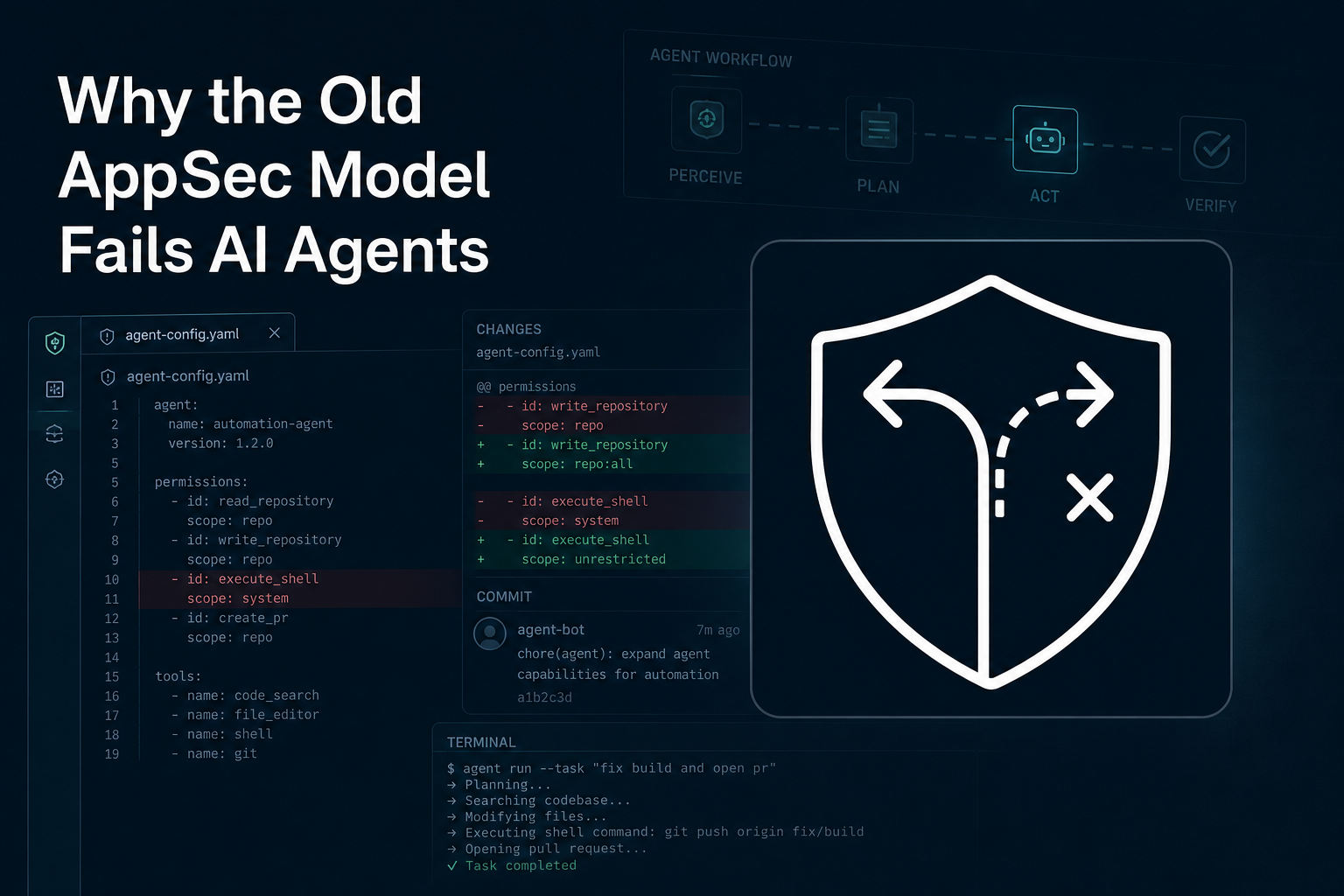

Traditional AppSec vs agentic AppSec isn't a debate about which tool is better. It's about whether your control model was built for a world where humans write code incrementally from workstations, or for one where cloud agents deliver full PRs with no human in the loop during generation. Most teams are still running the first model against the second reality. That mismatch is where the backlog comes from.
Gartner, among others, describes a shift in AI coding from code completion and chat to agents capable of executing multistep development tasks. As developers move from writing code to delegating and supervising agent-driven work, AppSec has to evolve with them.
AppSec was built around the assumption that a human writes the code. Agentic development breaks that assumption.
TLDR:
- AI coding agents bypass every traditional AppSec interception point: no IDE plugin fires, no pre-commit hook runs, no git author exists to route findings to
- AI-assisted developers introduce security findings at 10x the rate of peers, per a 2026 Cloud Security Alliance research note, breaking the scan-and-flag ratio
- 25.7% of AI-generated code contains confirmed OWASP Top 10 vulnerabilities; no major LLM consistently performs better than the others on security
- Agentic AppSec governance works by writing security policy into agent config files (.cursor/rules/, CLAUDE.md, .github/copilot-instructions.md) before any code is generated
- Arnica closes the agentic coverage gap through pipelineless SCM deployment, agent rules enforcement, and identity-graph-based routing for bot and departed-developer commits
What Traditional AppSec Was Built to Do
Traditional AppSec grew up around a clear mental model: a human developer writes code, pushes a commit, and a scanner somewhere in the pipeline checks it. That model held for decades, and every generation of tooling built on top of it.
The first generation, tools like Veracode and Checkmarx, were architected around deep scanning and compliance workflows, built primarily for security teams to govern codebases so developers could act on findings inline. The second generation, led by Snyk, fixed the experience problem with IDE plugins and developer-friendly workflows. But the underlying assumption stayed the same: a person writes code, incrementally, on a workstation, and the tool intercepts somewhere along that path.
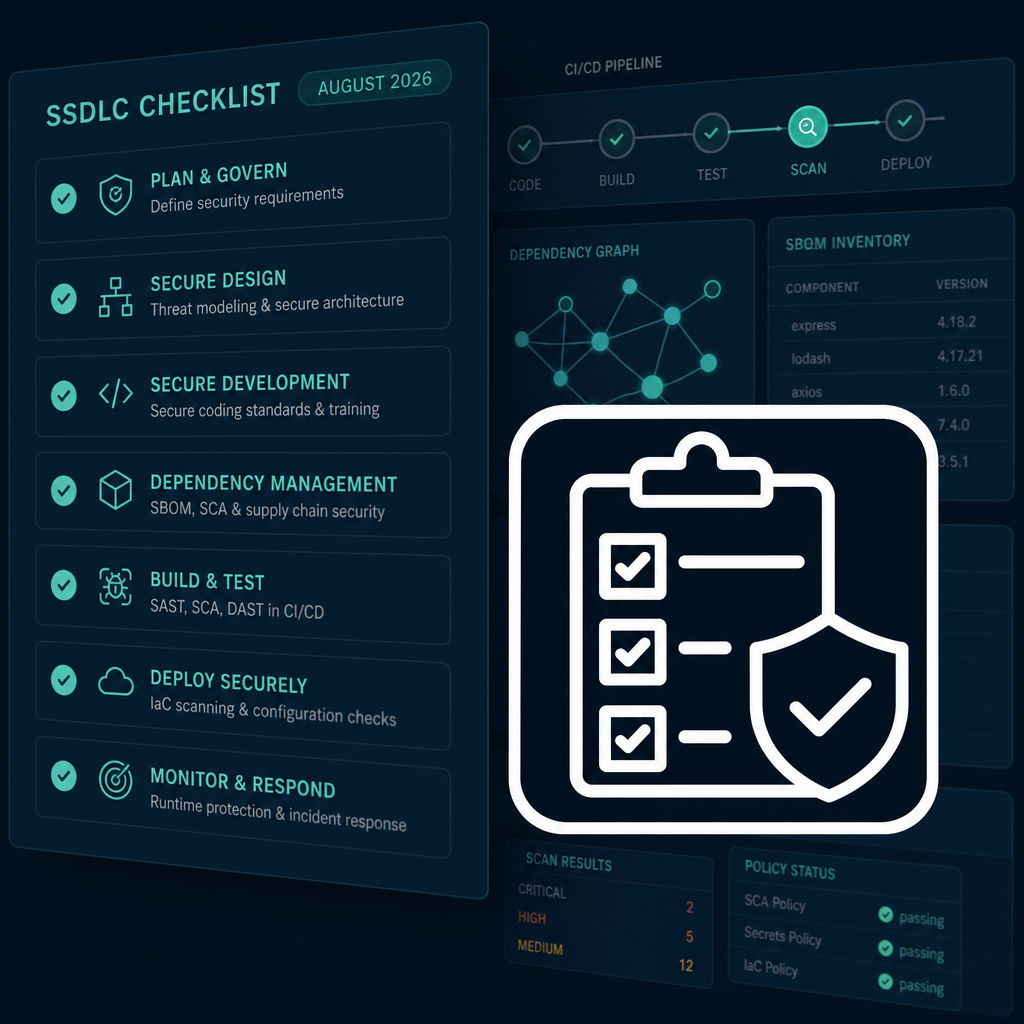
SAST, SCA, secrets detection, IaC scanning all operate on this principle. Code enters the pipeline and then the scanners run. Findings route back to whoever wrote the code. The chain from human intent to scannable artifact was predictable enough that this worked reasonably well for the conditions it was designed for.
AppSec was built for a world where humans write code. Every architectural choice, from pipeline hooks to IDE plugins to git-author-based routing, assumes a person initiated the change.
That assumption is now the source of the gap. Every control, every delivery mechanism, every ownership attribution model in traditional AppSec traces back to a human developer sitting at a keyboard.
Why the Human-Written Code Assumption Is Failing
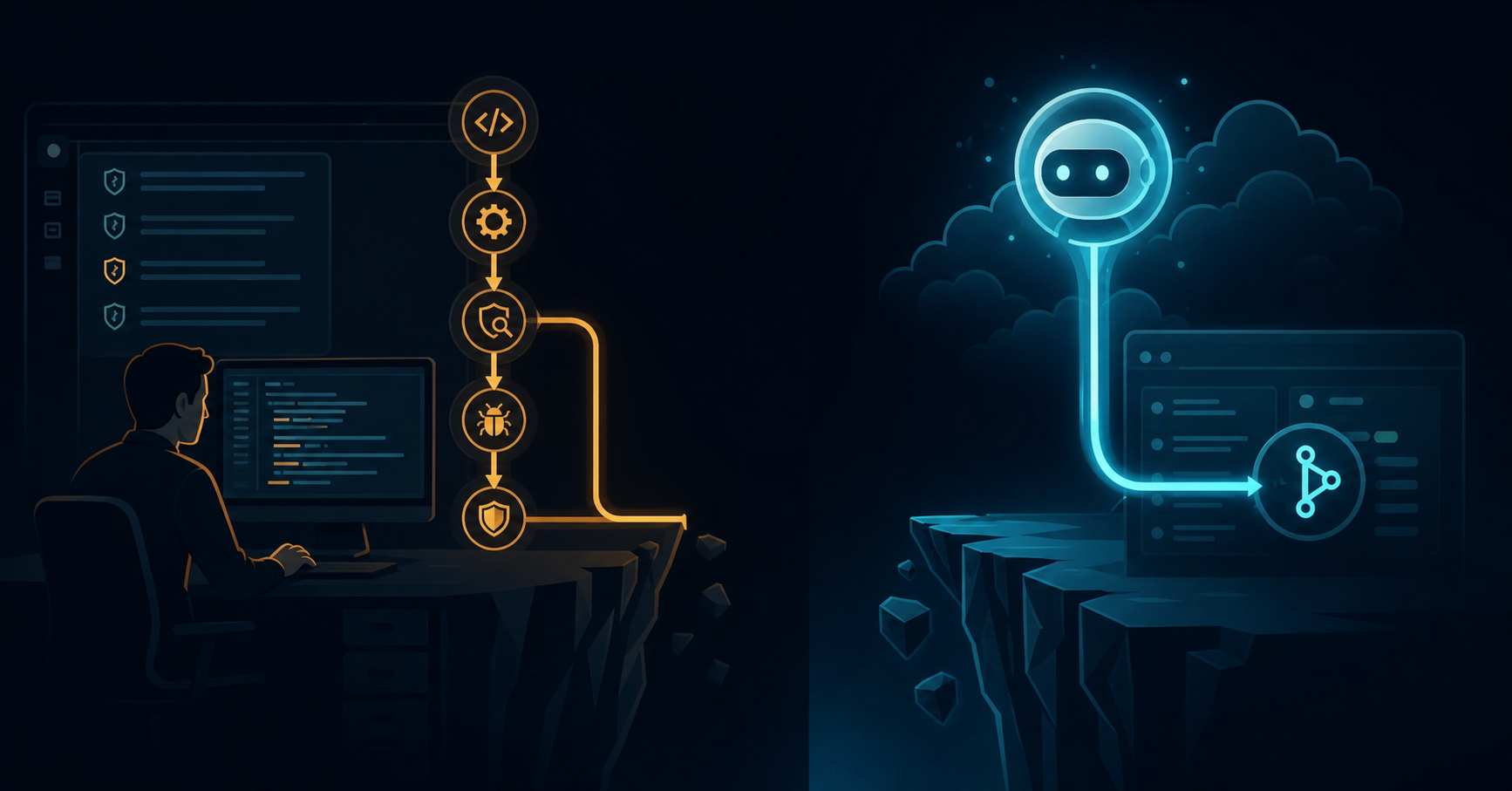
AI coding agents don't push code the way humans do. Cursor, GitHub Copilot, and Claude Code generate complete draft pull requests in a single pass, often running in the cloud with no developer workstation involved, a core part of the dangers of vibe coding. There's no incremental commit stream for a scanner to intercept. No IDE plugin fires. No pre-commit hook runs. The agent just delivers a finished PR.
This breaks traditional AppSec at the architecture level. Pipeline hooks were designed to catch code as it enters a CI/CD queue. IDE plugins were designed to warn a developer mid-keystroke. Git-author routing was designed to reach whoever typed the change. When an agent generates a full PR from a cloud environment, none of those interception points exist in a meaningful way. Industry estimates put IDE plugin adoption around 20% even for human developers, and agents have no IDE at all.
The mismatch isn't a configuration gap. You can't install a plugin on an agent. You can't tune a pipeline hook to catch code that bypassed the pipeline entirely. The assumptions baked into every traditional AppSec control, that a human initiated the change incrementally, on a workstation, through a predictable path, are structurally false for agentic workflows. Patching around that requires a different architecture, not a new rule.
The Scale Problem That Overwhelms Traditional Review
A 2026 Cloud Security Alliance research note found that AI-assisted developers produce commits at three to four times the rate of their peers but introduce security findings at 10x the rate. Security teams aren't growing at 10x but review queues are.
Scan-and-flag depends on a manageable ratio between findings generated and findings resolved. Once that ratio breaks, backlogs grow faster than anyone can work through them. Findings get triaged by severity alone, ownership goes stale, and most issues just sit and accumulate.
What AI-Generated Code Looks Like in Vulnerability Data
The vulnerability data is consistent enough to be uncomfortable. Testing by AppSec Santa across 534 code samples from six major LLMs found that 25.7% of AI-generated code contained confirmed vulnerabilities against OWASP Top 10 categories. A separate Veracode study cited by the Cloud Security Alliance put that figure at 45% across more than 100 LLMs tested on security-sensitive tasks, a pass rate that hasn't improved across multiple testing cycles from 2025 through early 2026, a finding the CSA notes holds despite vendor claims to the contrary.
The dominant patterns aren't exotic. Broken Access Control led the AppSec Santa findings, driven primarily by path traversal and server-side request forgery, with injection flaws and insecure configurations close behind. These are foundational categories that have appeared in the OWASP Top 10 for years. LLMs were trained on vast amounts of code that contains these same flaws. They reproduce what they've seen.
No major model consistently outperforms the others on security. GPT-5.2 had the lowest vulnerability rate in AppSec Santa's testing at 19.5%. Claude Opus 4.6, DeepSeek V3, and Llama 4 Maverick tied for the worst at 29.9%. There's no model you can simply trust to write secure code without review. At production scale, a 1-in-4 chance of a confirmed vulnerability per code sample compounds fast.
Where Specific Traditional Tools Fall Short
Each legacy tool category has a real purpose and still operates within its original design envelope. The problem is that envelope no longer covers the full codebase.
| Tool Category | Original Design Envelope | Agentic-Era Gap |
|---|---|---|
| SAST | Pattern/signature matching on human-authored code | Cannot assess multi-file intent or architectural correctness |
| SCA | Dependency risk from known package registries | Not designed to detect hallucinated package references in AI-generated code |
| IDE Plugins | Developer-initiated scanning at the workstation | ~20% industry adoption; agents have no IDE to install to |
Hallucinated packages are a particular blind spot. An AI coding agent can confidently reference a package that doesn't exist, and a standard SCA scanner will find nothing to flag. The dependency either resolves incorrectly at build time or, in more dangerous cases, gets squatted by a malicious actor.
IDE plugins were the developer-first AppSec answer for a decade. At 20% adoption, they were already leaving most of the codebase ungoverned before agents arrived. Agents made that gap permanent.
The New Attack Surface: Agents as Privileged Insider Actors
AI coding agents read secrets, traverse repositories, invoke infrastructure APIs, and operate with credentials scoped well beyond what any individual developer typically holds in a single session. That's a privileged insider-class actor running autonomously.
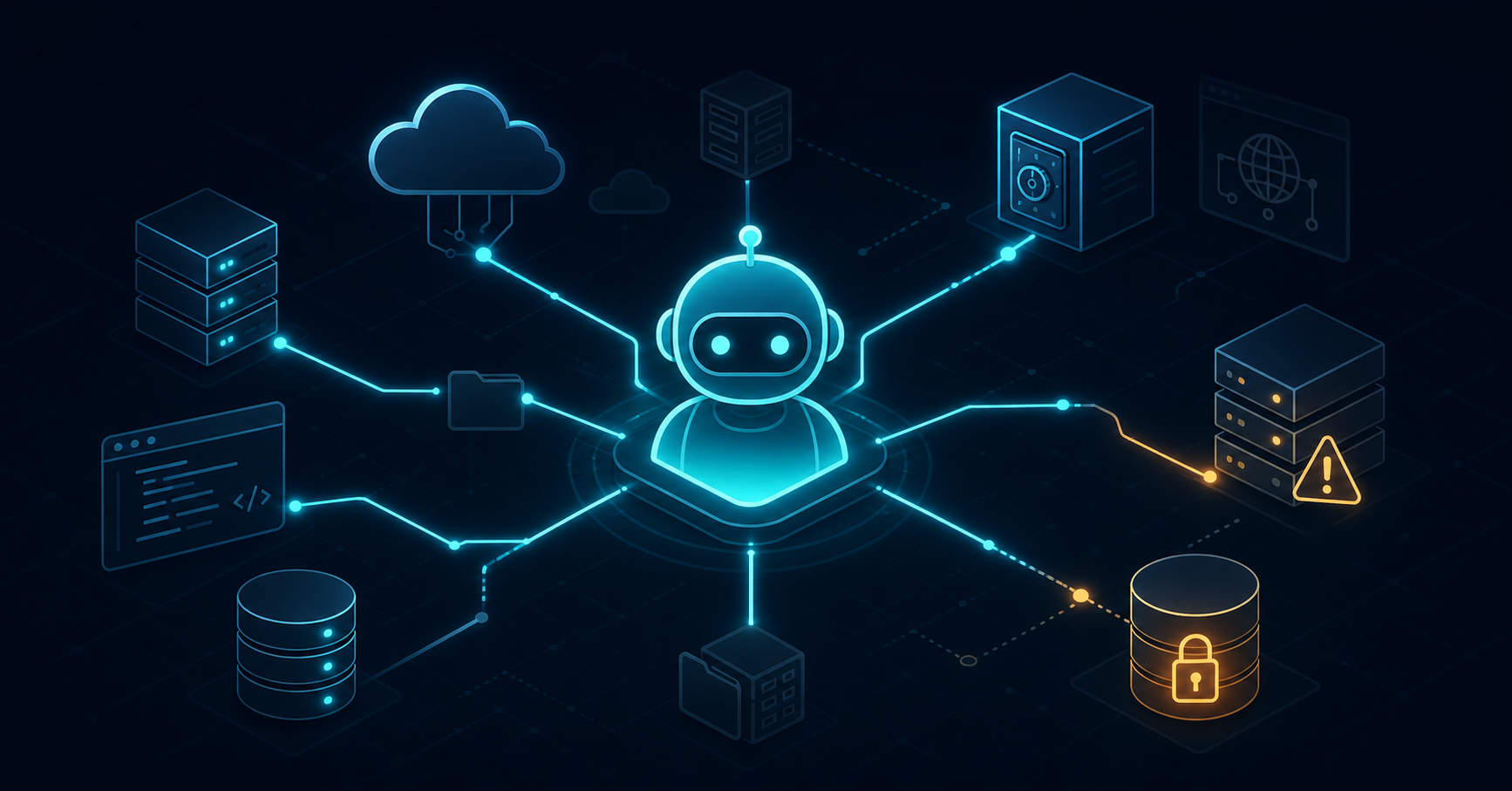
The threat surface this creates is categorically different from what traditional AppSec was built to handle. Scanning output assumes the agent's behavior was benign. But what if the agent's goal was hijacked mid-session, or an MCP server returned poisoned tool responses that redirected its actions? Perimeter-then-scan has no answer because the compromise happens before any scannable artifact exists.
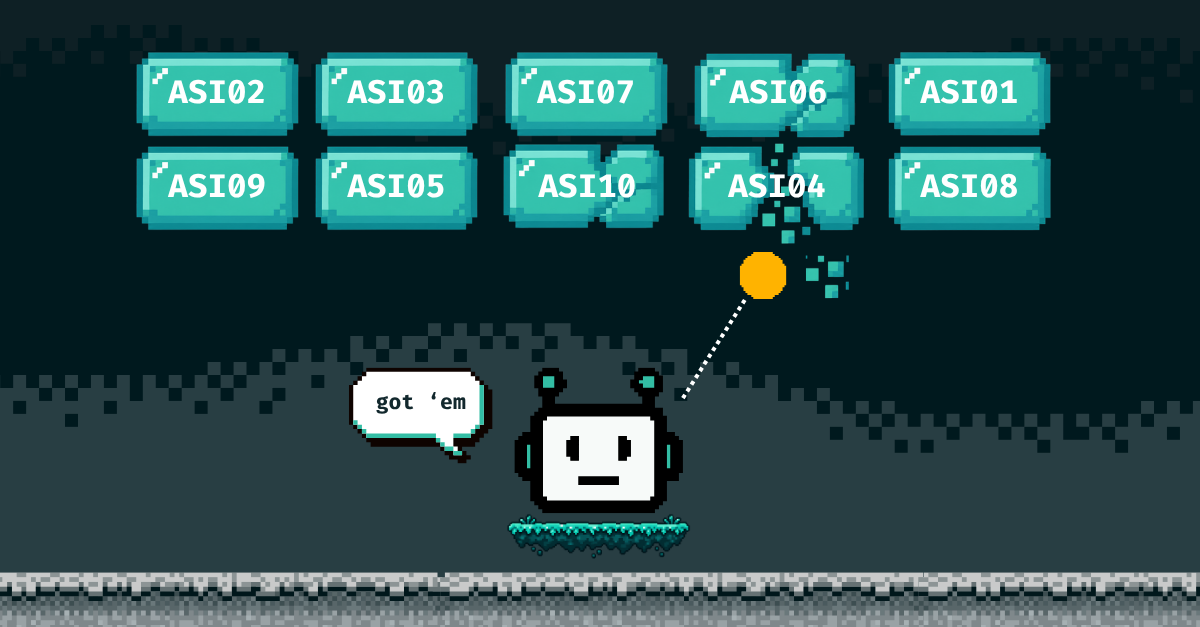
The OWASP Top 10 for Agentic Applications 2026 formally catalogs ten risk categories specific to this surface, including Agent Goal Hijack, Tool Misuse, Identity and Privilege Abuse, and Insecure Inter-Agent Communication. These are structural consequences of giving autonomous systems broad, privileged access across multiple systems without human checkpoints, not theoretical risks dressed in new terminology.
A 2026 Dark Reading readership poll found that 48% of security professionals identify agentic AI as the top attack vector. A scanner running after the PR is created cannot retroactively audit whether the agent was manipulated during generation, whether its credentials were abused mid-session, or whether its tool calls stayed within intended scope.
What Agentic AppSec Actually Means
Forrester formally introduced the Agentic Development Security (ADS) category, and its framing cuts through the noise: detection alone is no longer enough. The new operating model is built on four distinct capabilities: Prevent, Detect, Triage, and Remediate. Each one represents a structural departure from how traditional AppSec has operated.
The governance-first shift is the core change. In the traditional model, detection is the primary gatekeeper. In ADS, detection moves to a second line of defense, a confirmation layer that catches what prevention missed. That changes where controls live, when they run, and what infrastructure they require.
The Four Requirements of an Agentic AppSec Program
1. Prevent: Govern Agents Before Code Is Written
In a human-written code world, prevention meant warning a developer mid-keystroke with an IDE plugin, or blocking a commit at the pre-push hook. Neither mechanism reaches an agent running in the cloud. Governance at the generation step means writing security policy into the configuration files an agent reads before it generates a single line. The policy is present in the agent's context while it writes, not applied as a filter after. By the time a PR lands in the review queue, the controls were already in effect.
This is the structural reversal: in the traditional model, code is written first and scanned second. In an agentic program, policy shapes generation, and scanning confirms it. Prevention becomes the first line; detection becomes the second.
2. Detect: Reason About Meaning, Not Patterns
Traditional SAST matches code against known vulnerability signatures. That model has a hard ceiling: it can only find what its rule set anticipates. AI-generated code introduces context-dependent risk that doesn't appear in any rule pack, authorization gaps tied to feature flags, multi-file data exposures where sanitization in one file is bypassed by cache reads in another, insecure business logic that looks syntactically clean.
Agentic detection reasons about meaning and intent across files. It traces data flow, evaluates architectural correctness, and surfaces risk based on what code does, not what it looks like. That capability is what makes scanning AI-generated code credible rather than performative.
3. Triage: Surface What Actually Matters
At 10x the finding rate, scan-and-flag doesn't scale. A scanner that treats every output equally produces a backlog that grows faster than anyone can work it down. Triage in an agentic program is context-driven: exploitability over CVSS, reachability over theoretical exposure, active KEV status over static severity ratings. Findings that reached the review queue without that context become backlog items nobody owns.
Triage is also temporal. A Medium finding on the day of discovery can become critical the moment its CVE enters the CISA KEV catalog. A program that only triages at detection misses the window when the risk actually changed.
4. Remediate: Route to the Right Human
Remediation breaks where routing breaks. A finding that reaches a departed developer's inbox, a stale CODEOWNERS alias, or an unowned bot identity doesn't get fixed. It ages. Per Arnica's internal benchmark, 82% of findings were authored by developers no longer at the company. Cloud-agent commits add a second layer: a bot identity with no human owner in the git metadata.
Effective remediation in an agentic program requires an identity layer that resolves the current active human, not the original git author. That means mapping bot identities back to whoever initiated the session and routing to a security champion actively working in the relevant codebase when the original author is gone. Without that resolution, routing volume and routing accuracy move in opposite directions as the codebase ages.
Governing Agents Before They Write Vulnerable Code
Governance at the generation step, enforced through an agentic rules engine, means writing security policy into the configuration files an AI agent reads before it generates a single line. For Cursor, that's a .cursor/rules/ file. For Claude Code, a CLAUDE.md. For GitHub Copilot, .github/copilot-instructions.md. The agent reads the rule block on every run and shapes its output accordingly. By the time code reaches PR review, the policy was already applied.
The delivery mechanism matters as much as the concept. These rule files live in the repository itself, managed through the SCM connection. No per-workstation deployment, no per-developer credential setup. A cloud-run agent generating code on remote infrastructure reads the same rules as one running in a local IDE, because the rules travel with the repo. Coverage equals SCM coverage: every connected repository, including the ones where agents operate with no workstation in the loop at all.
Identity, Routing, and the Ownership Problem
Per Arnica's internal benchmark, 82% of findings were authored by developers no longer at the company. Route a finding to a departed developer and it lands in a dead inbox, breaking the developer feedback loop. Route it to a bot identity from a cloud coding agent and it lands nowhere. Severity doesn't matter if no one receives it.
Traditional AppSec tools route by git author email, a reasonable heuristic when humans wrote code incrementally from identifiable workstations. Cloud agents commit under bot identities with no clear human owner in the git metadata. The routing mechanism has no answer for that case, so the finding sits.
The fix requires an identity graph. Resolving the active human means mapping SCM identity, Slack or Teams identity, and agent-bot identity back to a single person through current repository activity, not a static CODEOWNERS file that nobody updates. When a Copilot Agent commit lands under a bot identity, the graph traces it back to whoever initiated the session. When the original author is gone, routing falls to a current security champion actively working in that codebase today.
Without that resolution layer, backlogs compound. A finding that can't reach a human who can act on it doesn't get remediated. It just ages.
Supply Chain Risks Specific to Agentic Development
Agentic development introduces supply chain attack vectors that don't appear anywhere in a traditional dependency graph.
The clearest example is slopsquatting. An AI coding agent confidently references a package that doesn't exist. An attacker registers that name with a malicious payload. The agent imports it, the build succeeds, and the compromise travels straight into production before any scanner sees a suspicious CVE. Standard SCA tools scan against known registries, so a hallucinated package name that resolves to a real malicious artifact looks clean until it isn't, part of why teams work to prevent vulnerabilities in AI coding assistants.
Three additional vectors follow the same logic:
- MCP server compromise: an agent trusts the tool responses it receives from connected MCP servers. Poison those responses and you redirect the agent's actions without touching a single line of the codebase directly. The attack surface runs through the agent's reasoning process, not the code it writes.
- Rules file tampering: an agent reads its security policy from a repository-resident configuration file. If an attacker modifies that file, every subsequent generation session runs under the compromised policy. The agent follows instructions faithfully. That's the problem.
- Tooling layer compromise: a supply chain attack routed through an open-source scanner runs silently through every codebase that scanner clears. If the scanning infrastructure itself is compromised, clean results become meaningless: the downstream codebases are implicitly cleared without actually being safe.
The threat model has to expand accordingly. The agent's inputs, the rules it reads, the tool servers it calls, and the scanning infrastructure downstream all belong inside it now.
Does Agentic AppSec Replace Traditional AppSec?
Agentic AppSec doesn't retire traditional tools. SAST still catches vulnerabilities in legacy codebases written long before any AI agent existed, an area covered in the Gartner agentic AST report. SCA still matters for known CVEs in real dependency graphs. Secrets scanning and IaC analysis stay relevant regardless of who or what wrote the code.
The restructuring is about where each layer sits in the control model. Traditional scanners move from primary gatekeeper to confirmation layer, covering repositories where AI coding tools haven't arrived yet and providing the audit baseline compliance programs require.
Where the transition is already necessary: any team running Cursor, GitHub Copilot, or Claude Code at scale needs governance controls upstream of the scanner. Scanning agent-written code afterward is still useful. Skipping policy and scanning later is the gap that accumulates into a backlog no team can close.
What agentic AppSec adds is a governance layer that runs before code exists, detection that reasons about meaning instead of matching patterns, and routing that survives bot-authored commits and developer attrition. The traditional stack stays. It just moves to a second line of defense instead of the first.
How to Assess Whether Your AppSec Program Has an Agentic Gap
Four questions expose where the gap actually lives. Answer them against your current tooling.
- Can you inventory what your agents are allowed to do? If you can't list every active agentic rule, MCP server, and agent skill across your environment right now, you have a blind spot covering every agent session running in any repository you lack explicit telemetry on.
- Does your routing survive cloud-agent commits and developer attrition? Pull up your last 20 unresolved findings and check the assigned owners. If a meaningful share trace back to departed developers or bot identities, your routing mechanism is broken for agentic conditions. Git author email was never designed for this.
- Can you attest that security policy was enforced at generation, per PR? Scanning a PR after it lands tells you what the agent wrote, not what policy it was operating under when it wrote it. Without that evidence per pull request, you can scan continuously and still not prove governance.
- Do your tools have visibility into agent configuration files? Agent rule files live in the repository. If your AppSec tooling isn't reading, governing, and monitoring
.cursor/rules/,CLAUDE.md,.github/copilot-instructions.md, and equivalent config files, those files are ungoverned inputs shaping every AI-generated output in your codebase.
Any gap here is an agentic coverage problem. The control model needs a layer upstream that traditional tools were never designed to provide.
How Arnica Closes the Agentic AppSec Gap
Each of those four requirements, Prevent, Detect, Triage, and Remediate, maps directly to a shipped capability in Arnica's architecture. That's the difference between a vendor that sells into a category and one built to deliver it.
Pipelineless security deployment via SCM events delivers 100% repository coverage from day one, no pipeline changes, no IDE plugins required. Cloud-run agents with no workstation are covered by default. The Agentic Rules Enforcer writes managed security policy directly into agent configuration files for Cursor, Claude Code, GitHub Copilot, Gemini, and Augment, so governed controls are present before the agent generates a single line. An identity graph, powered by Arnie AI, re-attributes cloud-agent commits to the prompting human and routes findings to active security champions when original authors have left. Adaptive Backlog Management re-engages current owners when a CVE enters the CISA KEV catalog or EPSS scores shift after the original scan, part of how AppSec for AI coding agents keeps pace with change.
Arnica is named in the Forrester Agentic Development Security Tools Landscape Q2 2026. Gartner recognizes Arnica as a Sample Vendor in three 2026 Hype Cycles: Platform Engineering (Software Supply Chain Security), Software Engineering, and Application Security. Latio Tech designated Arnica "Best for Mid-Market" in its 2026 AppSec Market Report.
Final thoughts on Building an AppSec Program That Covers AI-Generated Code
AI coding agents didn't break AppSec, they just exposed how much of it depended on assumptions that no longer hold. Your scanners still catch real things and your SCA still matters. But without governance at the generation step and routing that survives bot-authored commits, the findings that do surface have nowhere reliable to land. Adding that upstream layer is less about replacing what you have and more about making it work for the codebase you actually have today. Try Arnica free and see how agentic coverage connects with your existing AppSec stack.
FAQ
What AppSec tools can re-engage developers automatically when a CVE gets added to the CISA KEV catalog or EPSS spikes months after the original scan?
Arnica's Adaptive Backlog Management does this as a shipped capability: it monitors every historical finding against KEV additions, EPSS score changes, patch availability, severity changes, and new reachability evidence, then re-routes to the currently active developer through the identity graph and restarts the SLA timer with fresh context. Established AppSec tools, including Snyk and Endor Labs, re-score or continuously re-evaluate findings as scan inputs or cloud exposure changes (Snyk Risk Score re-evaluates daily as projects are re-tested, for example) but none trigger automatic developer re-engagement when a CVE is added to the CISA KEV catalog or EPSS moves materially months after the original scan.
Should I govern AI coding agents like Cursor, Claude Code, and GitHub Copilot with rules at generation time, or is scanning the PR afterward enough?
Scanning after the PR exists is still worth doing, but it misses the window where policy is cheapest to apply. When you write security rules into the configuration files an agent reads before it generates a single line (.cursor/rules/ for Cursor, CLAUDE.md for Claude Code, .github/copilot-instructions.md for Copilot), the governed controls are already present in the agent's generation context before the code reaches review. Scanning that code afterward then functions as a confirmation layer, not the primary gatekeeper, which is where it belongs given that 25 to 45% of AI-generated code across major LLMs contains confirmed vulnerabilities.
What is the best AppSec platform for teams dealing with PR review overload from AI-generated code?
Arnica is built for exactly this condition: pipelineless deployment covers every repository from day one, AI SAST reasons about meaning and intent across files instead of matching fixed signatures, and the identity graph routes each finding to the human who can act on it instead of a departed author or bot identity. For teams where PR review overload is the primary pain and the buyer is VP Engineering or CTO instead of AppSec, Arnica Code Review identifies files in a typical PR that are safe to skip before a reviewer touches the queue, cutting PR cycle time measurably.
How does traditional AppSec routing break when AI coding agents commit code under bot identities?
Traditional AppSec tools route findings by git author email, which has no answer when a cloud-run Copilot Agent or Cursor agent commits under a bot identity with no human in the git metadata. The finding routes to an unowned inbox or sits unassigned. Arnica's identity graph resolves this by mapping the bot identity and its initiating account back to the human who prompted the agent, so agent-authored code still has a human owner and findings reach someone who can actually act on them.
How do I enforce least-privilege scopes on MCP servers used by AI coding agents across all my repositories?
Start by inventorying every MCP server connected to agents in your environment: you cannot scope what you cannot see. Arnica's Agentic Asset Inventory surfaces every MCP, skill, and agentic rule across all connected repositories, and MCP security governance then enforces least-privilege tool scopes so each agent holds only the minimum permissions required for its defined task, reducing blast radius if an agent session is compromised. The OWASP Top 10 for Agentic Applications 2026 formally catalogs Tool Misuse and Identity and Privilege Abuse as structural risks from agents operating without these scoped permission controls.
Reduce Risk and Accelerate Velocity
Integrate Arnica ChatOps with your development workflow to eliminate risks before they ever reach production.