
Application Security Testing Tools: Complete Guide for CISOs (June 2026)


Everyone running application security testing tools today is using some combination of static application security testing tools, runtime application security testing tools, and software composition analysis. You've probably got open source security testing tools from GitHub, a few best SAST tools for early detection, some free DAST tools for runtime checks, and maybe a commercial tool from the Gartner Magic Quadrant for application security testing. Your security testing tools list covers web application security testing tools, cyber security testing tools, and automated security testing tools across the stack. But when agentic development takes over, your application security tools stop catching risk early because agents don't wait for your scan schedule. That's the shift we're dealing with in 2026, and it changes how CISOs need to think about what application security testing tools actually do.
TLDR:
- Applications are the most exploited entry point in 68% of global enterprise breaches.
- SAST scans code pre-execution, DAST tests running apps, SCA tracks open source risk across 70-90% of your codebase.
- IAST cuts false positives by tracking which vulnerable code paths actually execute during runtime.
- Free tools like Semgrep, OWASP ZAP, and Bandit cover SAST and DAST without vendor lock-in.
- Arnica injects security rules directly into agent config files across all repos before code lands, so your SAST layer scans cleaner input.
What Is Application Security Testing and Why It Matters
Application security testing (AST) is the practice of identifying and remediating vulnerabilities in software throughout its development lifecycle, from the first line of code through production deployment. It covers source code, open source dependencies, runtime behavior, and infrastructure configuration. General security controls like firewalls, endpoint detection, and network monitoring don't reach vulnerabilities embedded inside application logic.
The scope of the problem is real. Cyberattacks and data breaches affect roughly 68% of enterprises globally, and applications are consistently among the most exploited entry points. AST exists to close that gap before attackers find it.
The field organizes into four core methodologies:
- SAST (static application security testing) analyzes source code without executing it
- DAST (runtime application security testing) probes running applications from the outside
- SCA scans open source dependencies for known vulnerabilities
- IAST instruments applications at runtime, combining signals from both approaches
Each methodology targets different phases of development and different categories of risk, including the OWASP Top 10, the benchmark reference for the most commonly exploited web application vulnerability classes.
Core Types of Application Security Testing Tools
Application security testing tools fall into a few distinct categories, each catching different vulnerability classes at different points in the software development lifecycle.

There are three core types security teams rely on:
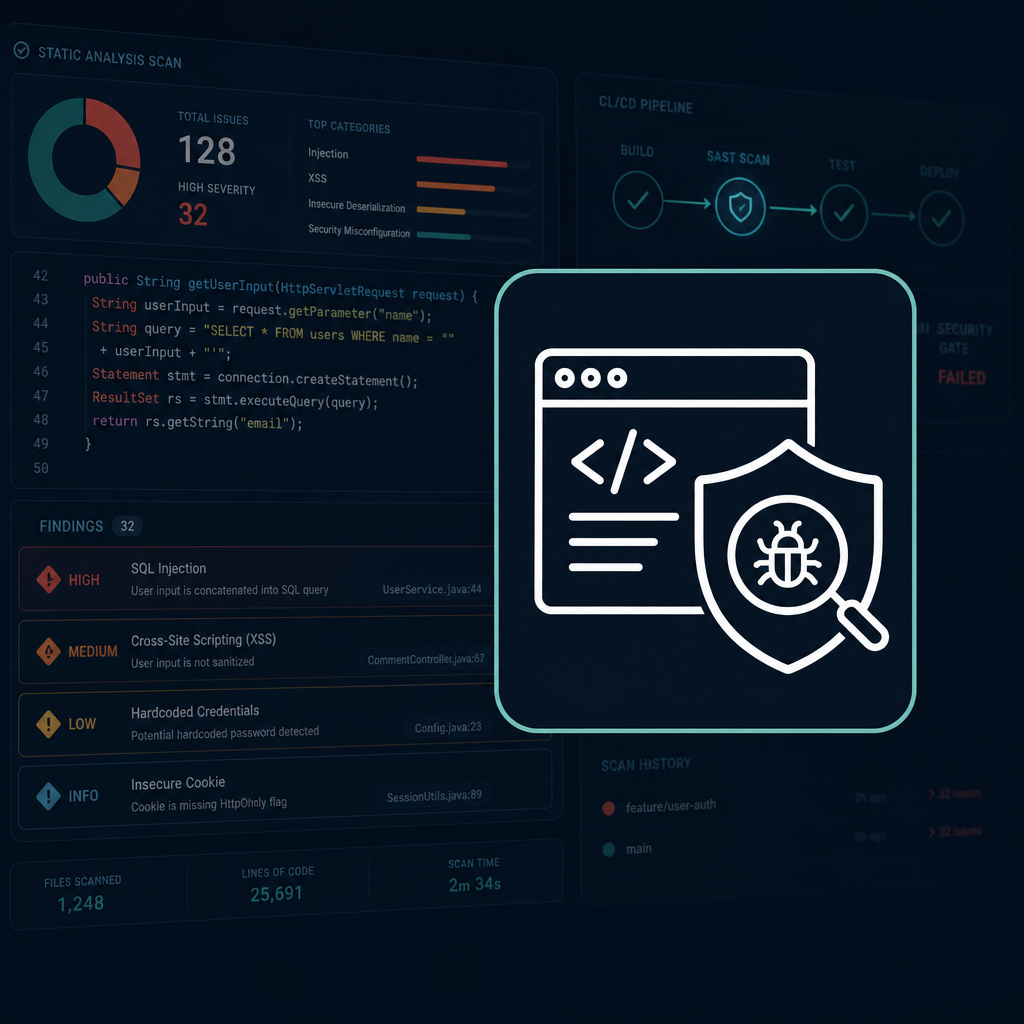
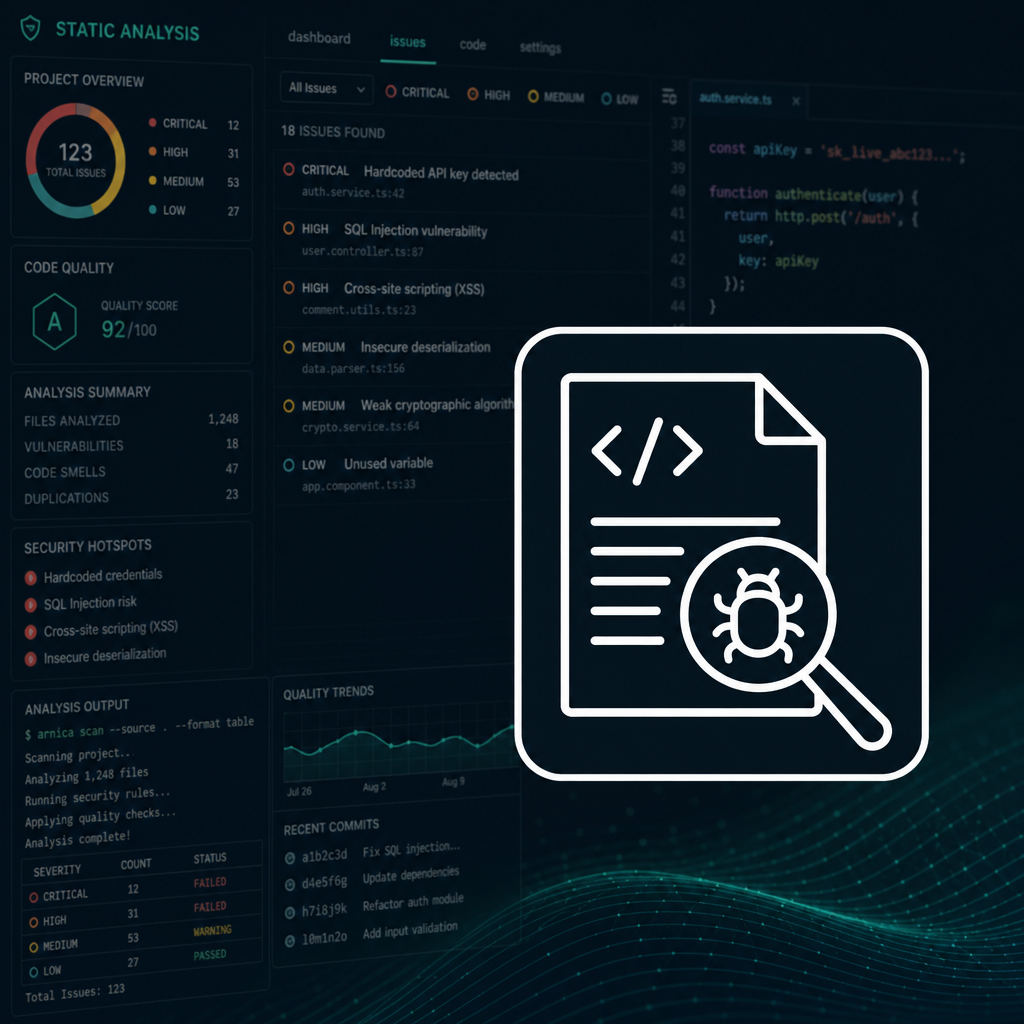
- SAST (Static Application Security Testing) analyzes source code, bytecode, or binaries without executing the application, catching issues like hardcoded credentials, injection flaws, and insecure configurations early in development.
- DAST (Runtime Application Security Testing) tests running applications by simulating real attacks against live endpoints, surfacing runtime vulnerabilities that static analysis misses entirely.
- SCA (Software Composition Analysis) inventories open source dependencies and flags known CVEs, license risks, and outdated packages across your codebase.
Most mature AppSec programs run all three in parallel instead of treating them as interchangeable alternatives.
| Testing Type | What It Scans | When It Runs | What It Catches |
|---|---|---|---|
| SAST | Analyzes source code, bytecode, or binaries without executing the application | Early in development during code review workflows | Hardcoded credentials, injection flaws, and insecure configurations before deployment |
| DAST | Tests running applications by simulating attacks against live endpoints | Against staging environments on every deployment after functional tests pass | Runtime vulnerabilities that static analysis misses, surfacing exploitable issues in production-like conditions |
| SCA | Inventories open source dependencies across 70-90% of your codebase | Whenever a new package is added to the dependency tree | Known CVEs, license risks, and outdated packages in third-party libraries |
| IAST | Instruments applications from inside during test execution to watch data flow through code | Attaches to test suite runs so every functional test doubles as a security scan | Confirms which vulnerable code paths actually execute, cutting false positives by tracking real data flow to dangerous sinks |
SAST vs DAST: Understanding the Difference
SAST analyzes source code without executing it, catching vulnerabilities early in the development cycle. DAST tests running applications by simulating attacks from the outside, finding issues that only appear at runtime. SAST vs. DAST is less about choosing one over the other.
Neither approach covers everything on its own. SAST misses runtime logic flaws and configuration errors. DAST cannot see deep into code-level weaknesses without executing the relevant paths.
Most security teams run both. The decision is less about which to pick and more about how to sequence them: SAST earlier in the pipeline where fixes are cheapest, DAST closer to staging where real runtime behavior can be observed.
A third category, IAST, sits between the two by instrumenting the running application to collect data from inside during test execution.
Software Composition Analysis for Open Source Security
Software Composition Analysis (SCA) sits at the intersection of supply chain security and application security testing. Most applications today are 70-90% open source code, which means your attack surface is largely determined by the libraries and dependencies your developers pull in, beyond the code they write.
SCA tools scan your dependency trees, flag known vulnerabilities via databases like the NVD and OSV, and check license compliance. The challenge is keeping up: new CVE disclosures have grown sharply year over year, with tens of thousands published annually.
Key capabilities in effective SCA tooling:
- Reachability analysis to confirm whether a vulnerable function is actually called in your code, cutting false positives sharply
- Transitive dependency scanning that goes beyond direct dependencies into nested packages
- License risk flagging for copyleft licenses that could affect your distribution rights
- Fix prioritization that accounts for exploitability alongside CVSS score
SCA integrates naturally alongside SAST and DAST in a mature AppSec program, covering the third major source of application risk.
Interactive Application Security Testing: Combining SAST and DAST
IAST instruments your application from the inside during test execution, watching how data flows through the code in real time. Where SAST flags a potential injection point and DAST confirms an endpoint responds, IAST tells you exactly which line of code processed the malicious input and whether it reached a dangerous sink. That combination cuts false positives sharply because a finding only surfaces when real execution confirms the vulnerable path was actually traversed.
The CI/CD fit is natural. IAST agents attach to your test suite runs, so every functional test doubles as a security scan with no separate scan window required. Coverage grows alongside your test coverage. Teams moving toward continuous testing get continuous security signal without waiting for scheduled scans between releases.
Integrating Security Testing Into DevSecOps Workflows
Security testing works best when it runs automatically, not as a gate before release but as a continuous signal throughout development. SAST scans each pull request before merge, catching issues during code review. DAST runs against staging environments on every deployment. SCA checks dependencies whenever a new package is added.
The goal is fast feedback. Developers fix issues in the same context where they wrote the code, which cuts remediation time and reduces the back-and-forth between security and engineering teams.
Three things determine whether this integration holds up in practice:
- Pipeline coverage matters less than trigger logic. Scans that only run on main branch miss most of the risk.
- Noise kills adoption. If every scan produces hundreds of low-severity findings, developers stop reading the results.
- Ownership has to be clear. Security teams set policy; developers own remediation.
Open Source and Free Application Security Testing Tools
Budget constraints are real. The open source ecosystem has matured enough that free tools can cover substantial ground across both SAST and DAST categories.
For SAST, Semgrep offers fast, customizable static analysis with a strong rule library on GitHub. Bandit covers Python-specific security checks. SpotBugs with the FindSecBugs plugin handles Java. For DAST, OWASP ZAP remains the most widely used free web application security testing tool, with active community support and CI/CD integrations.
A few things to keep in mind when choosing free options:
- Coverage gaps are common, especially for proprietary frameworks or newer vulnerability classes
- Community support replaces vendor SLAs, so internal expertise matters more
- GitHub-hosted tools vary widely in maintenance activity; check commit recency before adopting
Selecting Application Security Testing Tools: Key Criteria
Three factors separate tools that hold up at scale from those that create new blind spots.
- Coverage across your stack: A tool that scans Java but misses your Go microservices or infrastructure-as-code configurations leaves real gaps. Match tool coverage to your actual tech stack before anything else.
- Integration with your CI/CD pipeline: Security findings that require manual review outside the developer workflow get ignored. Tools that surface results where developers already work get fixed.
- False positive rate: High noise kills adoption. A SAST tool flagging hundreds of irrelevant issues trains teams to ignore alerts, which defeats the purpose entirely.
How Arnica Secures the Agentic Development Lifecycle
Arnica governs the step before the code lands. The Agentic Rules Enforcer writes a managed security rule pack into each agent's configuration files across every connected repository, pipelinelessly, with no per-developer setup required. Coverage equals SCM coverage from day one.
When a rule is updated, it propagates instantly across every agent. Security policy travels with the agent, not the pipeline. That means agentic PRs arrive with security rules already applied. The SAST or DAST layer inherits cleaner code to scan instead of triaging issues that should never have been introduced.
Final Thoughts on Security Testing for Applications
No single testing tool catches everything, which is why mature programs run SAST, DAST, and SCA together. SAST scans code before it runs, DAST tests live behavior, and SCA tracks open source risk across your dependency tree. The real question is whether your testing happens early enough that fixes are cheap and fast. Arnica's agentic rules run before code generation, so your agents produce secure output from the start instead of creating technical debt for later.
FAQ
SAST vs DAST: Which should I run first if I'm starting from zero?
SAST. It catches vulnerabilities while developers still have the code context loaded, making fixes faster and cheaper than post-deployment remediation. DAST follows naturally once you have staging environments and predictable deployment cadences, but the first security signal should reach developers at commit time.
What's the difference between static application security testing and runtime application security testing tools in practice?
Static application security testing tools analyze source code without running it, catching issues like hardcoded credentials and injection flaws early in development. Runtime application security testing tools probe running applications from the outside, finding runtime vulnerabilities that static analysis misses. Most security programs run both because neither approach covers everything on its own.
Can I build an effective AppSec program using only free and open source security testing tools?
Yes, but coverage gaps are common. Semgrep (SAST), OWASP ZAP (DAST), and dependency-check (SCA) form a solid free foundation on GitHub, but you'll need internal expertise to tune rules, interpret findings, and handle maintenance when community support lags. Free tools work best when paired with strong internal security knowledge instead of as a complete replacement for commercial platforms.
How do I know if my application security testing tools have too many false positives?
If developers start ignoring scan results or routing all findings directly to a backlog they never revisit, your false positive rate is too high. A healthy signal-to-noise ratio means at least 60-70% of flagged issues are actionable findings that developers can confirm and fix within their normal workflow.
What is runtime application security testing and when should it run in my pipeline?
Runtime application security testing probes running applications by simulating real attacks against live endpoints, surfacing runtime vulnerabilities that code analysis alone cannot detect. It should run against staging environments on every deployment, after functional tests pass but before production release, so teams catch exploitable issues in conditions that mirror production without risking live systems.
Reduce Risk and Accelerate Velocity
Integrate Arnica ChatOps with your development workflow to eliminate risks before they ever reach production.